
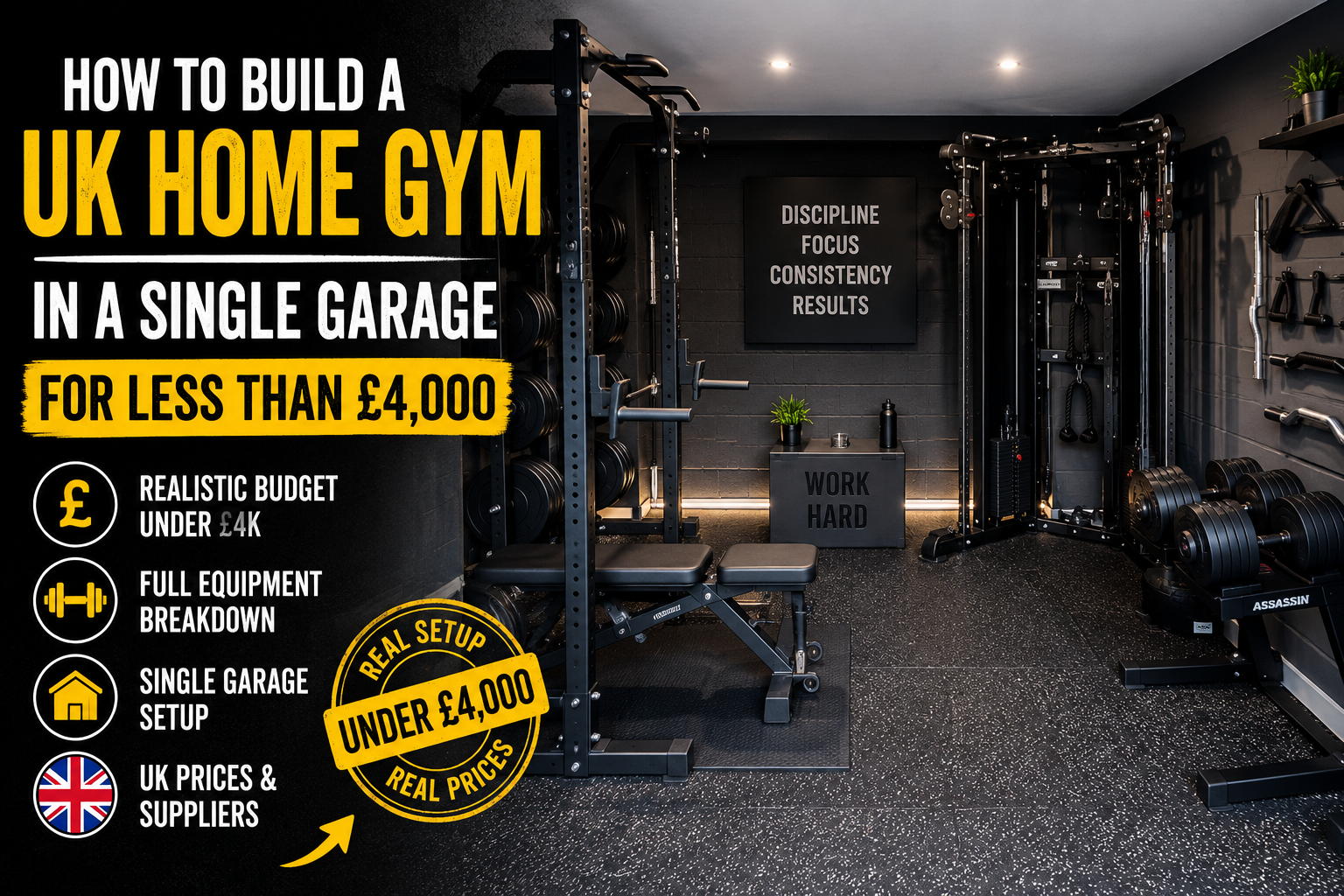
For many people, the idea of owning a home gym feels like a dream reserved for professional athletes, fitness influencers, or wealthy entrepreneurs with enormous houses and unlimited budgets. Browse YouTube for inspiration and you will quickly find garage gyms packed with commercial equipment, premium flooring, custom lighting, and enough machines to rival a professional fitness centre. The problem is that most people do not have £50,000 to £100,000 available to spend on a gym.
The reality is that the average person simply wants a practical space where they can train consistently without commuting to a commercial gym. They want something that fits into a normal home, works around a busy family schedule, and provides enough equipment to build muscle, lose fat, and stay healthy.
That is exactly what makes a realistic single garage gym setup so appealing.
With careful planning, smart equipment choices, and a budget of less than £4,000, it is possible to create a highly functional training environment that supports almost every fitness goal. Whether you are a busy parent, a shift worker, an entrepreneur, or simply someone who prefers training at home, a well-designed garage gym can transform your fitness journey.
This guide explores how one UK homeowner converted a standard single garage into a complete training facility without breaking the bank, while highlighting the lessons anyone can use when creating their own home gym.
Why More People Are Building Home Gyms In The UK
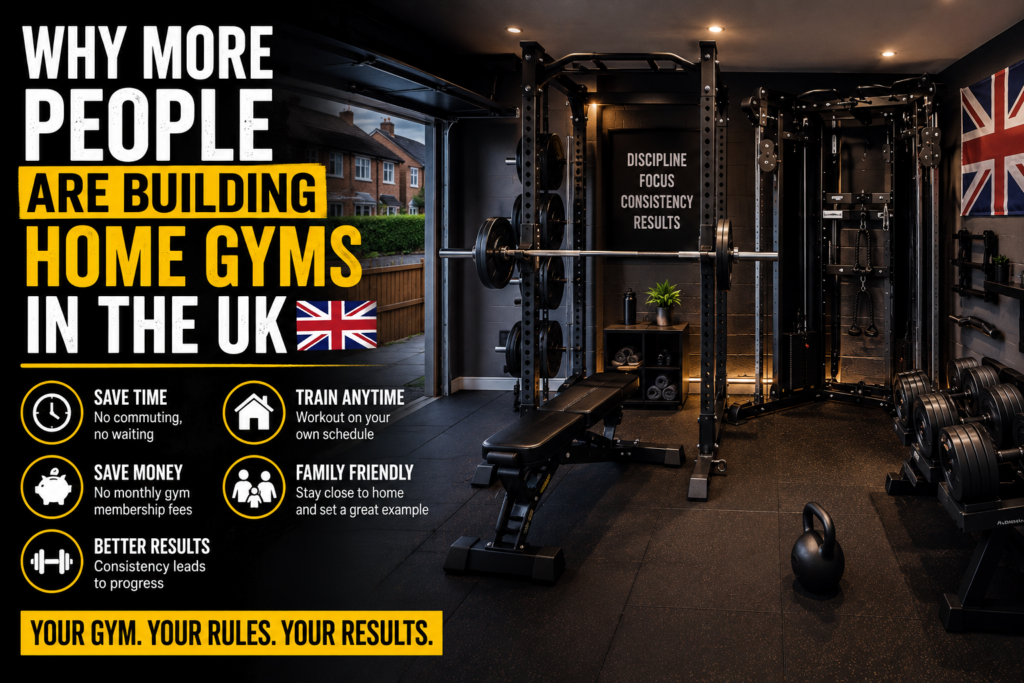
The popularity of home gyms has exploded in recent years.
Part of this growth came from the lockdown years when commercial gyms closed for extended periods. However, many people discovered benefits that extended far beyond temporary restrictions.
Time is perhaps the biggest advantage.
For someone working long hours, commuting to a gym can easily add another hour or more to their day. Between driving, parking, changing clothes, waiting for equipment, and travelling home, a one-hour workout can become a two-hour commitment.
A home gym eliminates almost all of that wasted time.
You simply walk into your garage and begin training.
Parents especially benefit from this arrangement. Instead of arranging childcare or coordinating schedules around gym visits, they can train while remaining close to home. Many also appreciate the positive example it sets for their children.
When children regularly see parents exercising, lifting weights, and prioritising health, fitness becomes a normal part of everyday life rather than something unusual.
Financially, a home gym can also make sense.
A family gym membership can easily cost £100 to £200 per month. Over several years, those expenses often exceed the cost of purchasing quality equipment outright.
The convenience, flexibility, and long-term savings explain why more homeowners are transforming garages, spare rooms, and garden buildings into dedicated training spaces.
Planning Your Garage Gym Before Buying Equipment
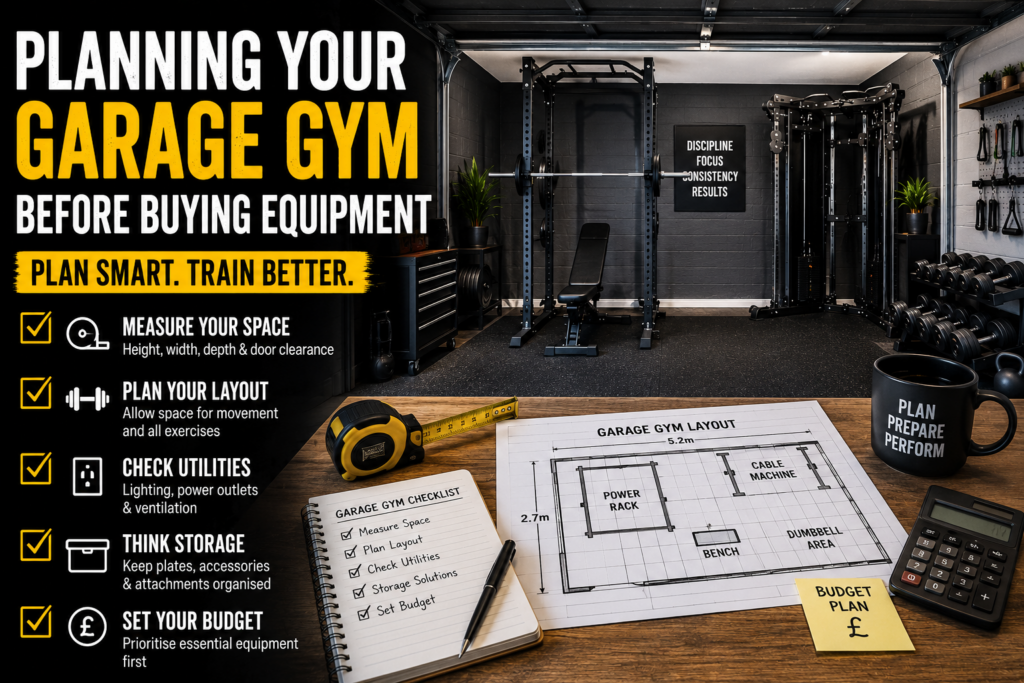
One of the biggest mistakes people make is purchasing equipment before properly measuring their space.
A garage gym is different from a commercial gym because every centimetre matters.
The homeowner featured in this setup spent considerable time measuring ceiling heights, wall lengths, and equipment dimensions before making any purchases.
This planning stage prevented expensive mistakes.
Ceiling height was particularly important.
Many power racks and cable machines are designed for commercial facilities with higher ceilings. In a typical UK single garage, some equipment simply will not fit.
A pull-up bar that is too high can become unusable. A rack that touches the ceiling may not even be assembled properly.
Before buying anything, consider:
- Ceiling height
- Floor dimensions
- Door placement
- Lighting
- Electrical outlets
- Ventilation
- Storage requirements
It is also important to think about movement space.
Equipment that technically fits may still leave insufficient room for exercises such as deadlifts, lunges, hip thrusts, or stretching.
A good garage gym should feel functional rather than cramped.
Creating a simple floor plan before purchasing equipment can save hundreds of pounds and countless headaches later.
Choosing A Corner Cable Machine To Maximise Space
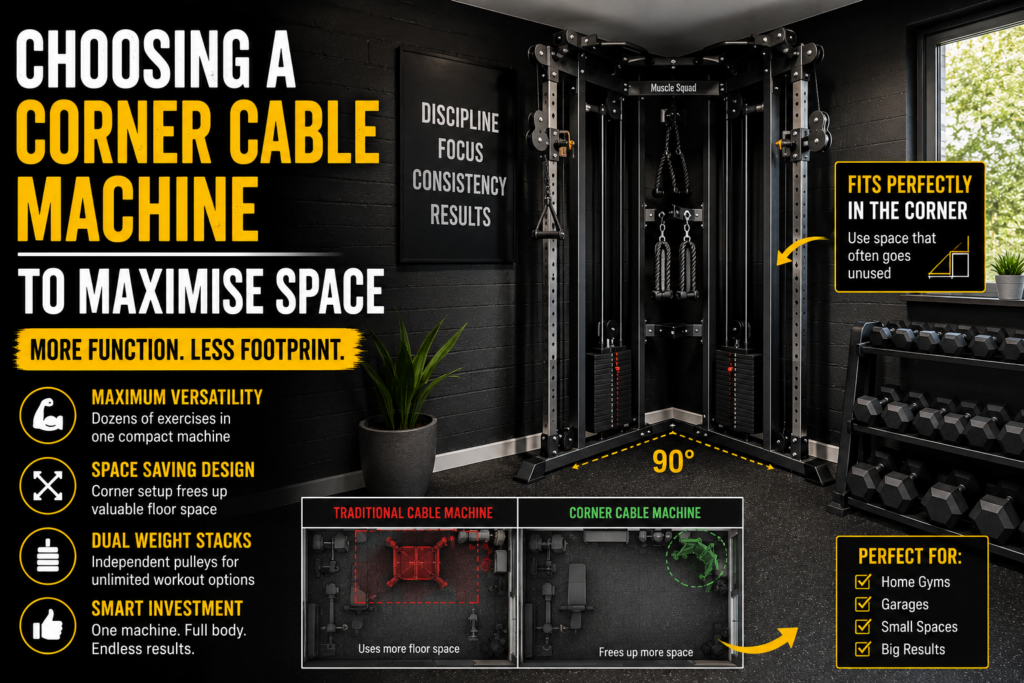
The most expensive piece of equipment in this setup was a dual cable machine costing approximately £1,680.
At first glance, this might seem expensive for a budget-conscious gym. However, cable machines offer unmatched versatility.
With one machine, users can perform:
- Lat pulldowns
- Tricep pushdowns
- Cable flyes
- Face pulls
- Rows
- Bicep curls
- Lateral raises
- Core exercises
Essentially, one machine replaces several individual machines found in commercial gyms.
The clever feature here was the corner design.
Traditional cable machines often occupy a large amount of floor space. By fitting neatly into a corner, this machine utilised an area that would otherwise be difficult to use efficiently.
This allowed the rest of the garage to remain open for free weights and other equipment.
Another advantage was the built-in pull-up capability.
Pull-ups remain one of the most effective upper-body exercises available, making this addition especially valuable in a compact gym.
The machine provided smooth operation, multiple attachment options, and a weight stack reaching nearly 47 kilograms per side.
For most home gym users, this level of resistance is more than adequate for years of progression.
When building a garage gym, investing in versatile equipment often delivers far greater value than purchasing multiple specialised machines.
Why A Folding Power Rack Is Perfect For Small Garages
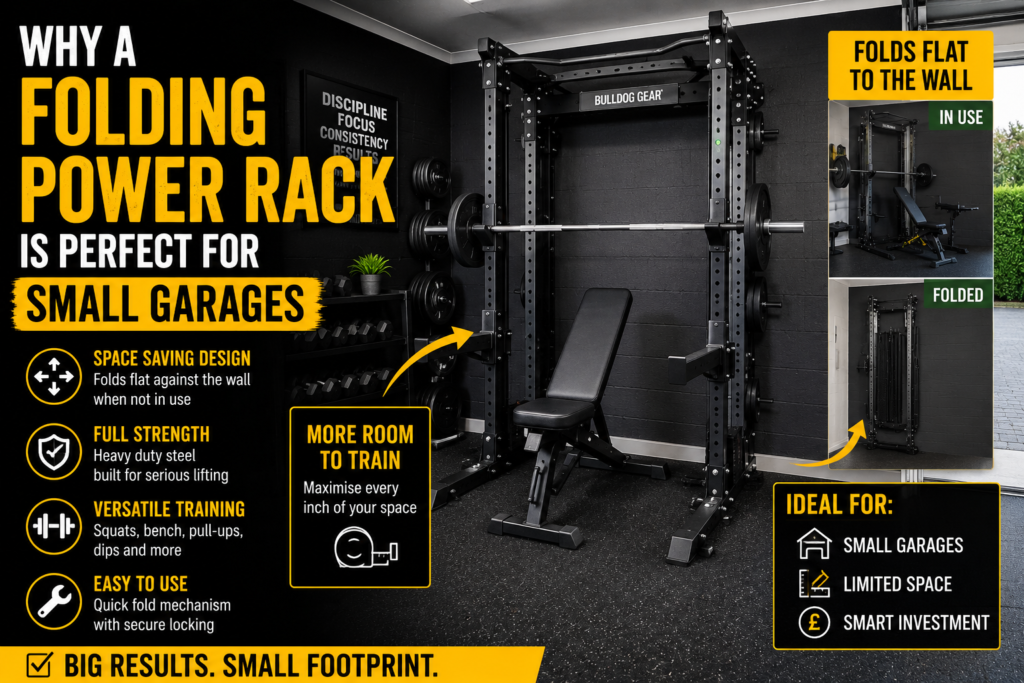
A power rack is the heart of most serious home gyms.
It provides a safe environment for:
- Squats
- Bench presses
- Overhead presses
- Pull-ups
- Rack pulls
- Barbell rows
The challenge is that traditional power racks can consume significant space.
The solution in this setup was a wall-mounted folding rack.
Although the rack remained permanently extended due to installation issues, the design still offered tremendous space efficiency compared to a full commercial rack.
The rack cost approximately £595, with an additional dip attachment costing £115.
For less than £750 total, the owner gained access to virtually every major compound lift.
This is important because compound movements deliver exceptional training efficiency.
Exercises such as squats, deadlifts, presses, and pull-ups recruit multiple muscle groups simultaneously, helping users build strength and muscle while saving time.
The rack also included a pull-up bar and compatibility with additional attachments such as safety arms.
For most home gym owners, a power rack should rank among the first major purchases because of its versatility and long-term usefulness.
Unlike cardio equipment that often ends up gathering dust, a quality rack remains relevant throughout an entire fitness journey.
Adjustable Dumbbells Save Space And Money
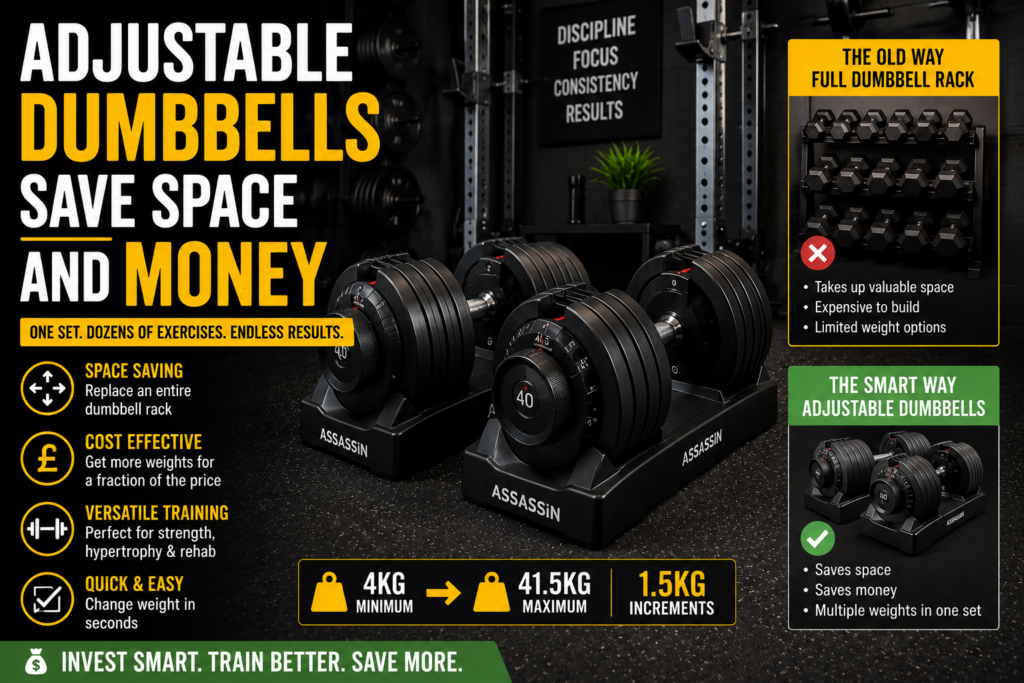
Perhaps no equipment demonstrates the value of modern home gym innovation better than adjustable dumbbells.
Traditional dumbbell collections require substantial space.
A complete set from 4 kilograms to 40 kilograms can occupy an entire rack and cost thousands of pounds.
Adjustable dumbbells solve this problem beautifully.
The adjustable dumbbells in this setup ranged from 4 kilograms to over 41 kilograms and cost approximately £543 including the stand.
To achieve the same weight range using fixed dumbbells would likely cost several times more.
Space savings are equally impressive.
Instead of dedicating an entire wall to dumbbell storage, the owner only needed a compact stand.
The weight adjustment increments of 1.5 kilograms also allowed for gradual progression.
This is particularly useful for smaller muscle groups where larger jumps in weight can feel overwhelming.
For example:
- Lateral raises
- Bicep curls
- Tricep extensions
- Rear delt exercises
These exercises often benefit from smaller increases in resistance.
The only drawback mentioned was the need to carefully return weights to their storage base after use.
However, this minor inconvenience is insignificant compared to the massive savings in both money and floor space.
For most single-garage gyms, adjustable dumbbells are among the smartest purchases available.
The Importance Of A Quality Bench And Barbell
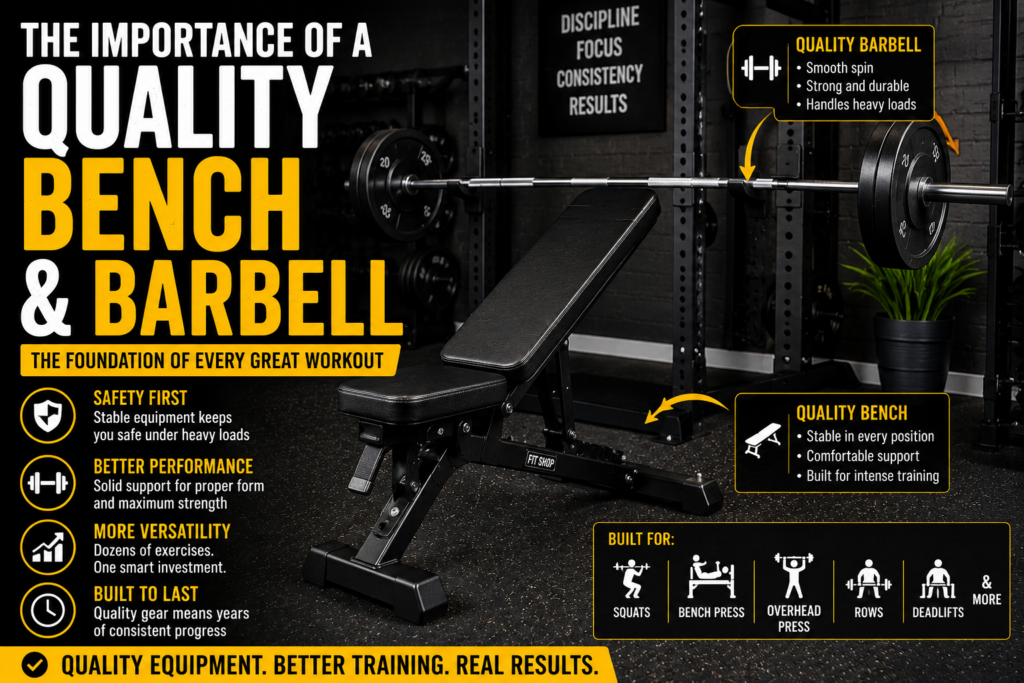
While cable machines and racks often receive most of the attention, benches and barbells deserve equal consideration.
A poor-quality bench can ruin workouts.
Unstable benches create discomfort and can even become dangerous when lifting heavy weights.
The adjustable bench used in this setup cost approximately £280 and offered excellent stability.
Its adjustable positions allowed for:
- Flat bench presses
- Incline presses
- Seated shoulder presses
- Dumbbell rows
- Various abdominal exercises
A strong adjustable bench dramatically increases exercise variety without consuming much space.
The same principle applies to barbells.
The owner selected a quality seven-foot Olympic barbell costing approximately £138.
Although cheaper options exist, investing in a durable barbell makes sense because it will likely remain the most frequently used piece of equipment in the gym.
A good barbell supports:
- Squats
- Deadlifts
- Bench presses
- Overhead presses
- Rows
- Romanian deadlifts
- Olympic lifts
Few pieces of equipment offer greater training value.
For budget-conscious gym builders, purchasing a quality bench and barbell can provide years of reliable service and form the foundation of countless effective workouts.
Flooring Heating And The Small Details That Matter
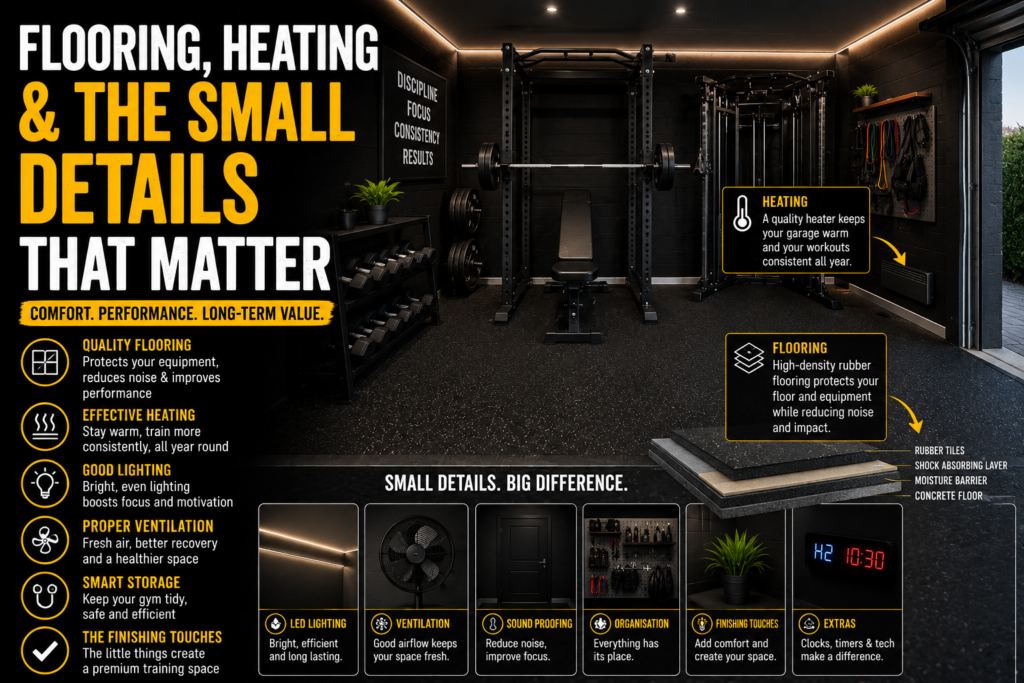
Many people focus entirely on equipment and overlook the details that make a gym enjoyable to use.
Flooring is one example.
Without proper flooring, training can become uncomfortable and potentially damaging to the underlying concrete surface.
Rubber flooring provides:
- Joint protection
- Equipment protection
- Noise reduction
- Improved aesthetics
- Better grip
Fortunately, effective flooring does not need to be expensive.
Simple rubber flooring purchased from a DIY retailer can provide excellent results at a reasonable cost.
Heating is another important consideration in the UK.
British winters can make garage training uncomfortable.
A small electric heater costing around £40 transformed this garage into a year-round training environment.
Interestingly, the owner noted that after ten minutes of exercise, the gym often became too warm rather than too cold.
Lighting, ventilation, and storage also contribute significantly to the overall experience.
Small improvements in comfort can dramatically increase consistency.
After all, the best gym is not necessarily the most expensive gym.
The best gym is the one you actually use.
How To Build Your Own Garage Gym For Less Than £4,000
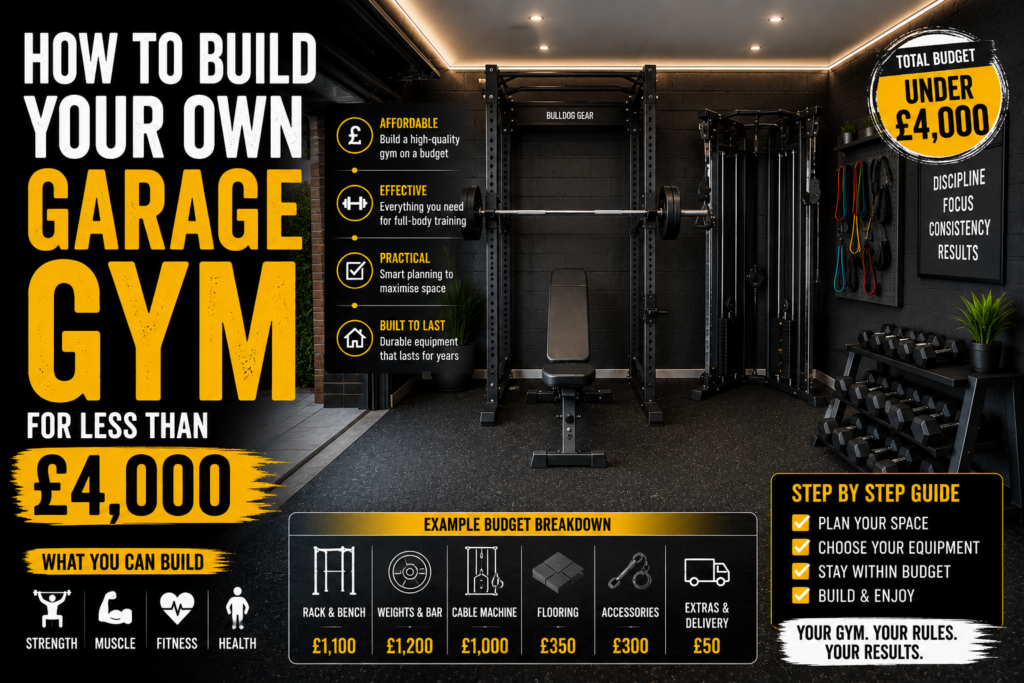
The greatest lesson from this setup is that you do not need unlimited space or a huge budget to create an exceptional training environment.
A practical budget allocation might look like this:
- Cable machine: £1,680
- Folding rack: £595
- Dip attachment: £115
- Adjustable dumbbells: £543
- Adjustable bench: £280
- Barbell: £138
- Flooring: £200 to £400
- Heater and accessories: £100
Total investment: approximately £3,700 to £3,900
This provides virtually everything needed for:
- Strength training
- Muscle building
- Fat loss
- Athletic performance
- General fitness
Even better, many items can often be purchased second-hand through Facebook Marketplace, reducing costs even further.
For those starting from scratch, it may make sense to build gradually.
Begin with:
- Rack
- Bench
- Barbell
- Plates
Then add:
- Adjustable dumbbells
- Cable machine
- Accessories
This phased approach spreads the cost while still providing excellent training options from day one.
Ultimately, the goal is not to create the most impressive gym on Instagram.
The goal is to create a space that supports consistent training, better health, and long-term fitness success.
A single garage may seem small, but with intelligent planning and carefully selected equipment, it can become a powerful environment for transforming your physique and improving your quality of life.
For busy professionals, parents, and anyone seeking greater convenience, a well-designed home gym may be one of the best investments they ever make. The freedom to train whenever you want, without crowds, commuting, or membership fees, creates opportunities for consistency that many commercial gyms simply cannot match.
And as this setup proves, you do not need £100,000 to make it happen. With less than £4,000, a single garage can become a complete fitness facility capable of delivering years of progress, strength, and better health.
Disclaimer
The information provided in this article is for educational and informational purposes only. While every effort has been made to ensure accuracy, the content is not intended to replace professional medical, nutritional, fitness, or healthcare advice.
The views and concepts discussed are based on publicly available information, scientific research, expert opinions, and interpretations of the topics covered. Individual health needs, dietary requirements, and fitness goals vary from person to person, and results may differ.
Before making significant changes to your diet, exercise routine, supplementation, or lifestyle habits, you should consult with a qualified healthcare professional, registered dietitian, physician, or other appropriate medical expert.
The author and publisher assume no responsibility for any loss, injury, or damage resulting from the use of information contained in this article. Readers are encouraged to conduct their own research and make informed decisions based on their individual circumstances.
By reading this article, you acknowledge that any actions you take based on the information provided are done at your own discretion and risk.ented in this article.