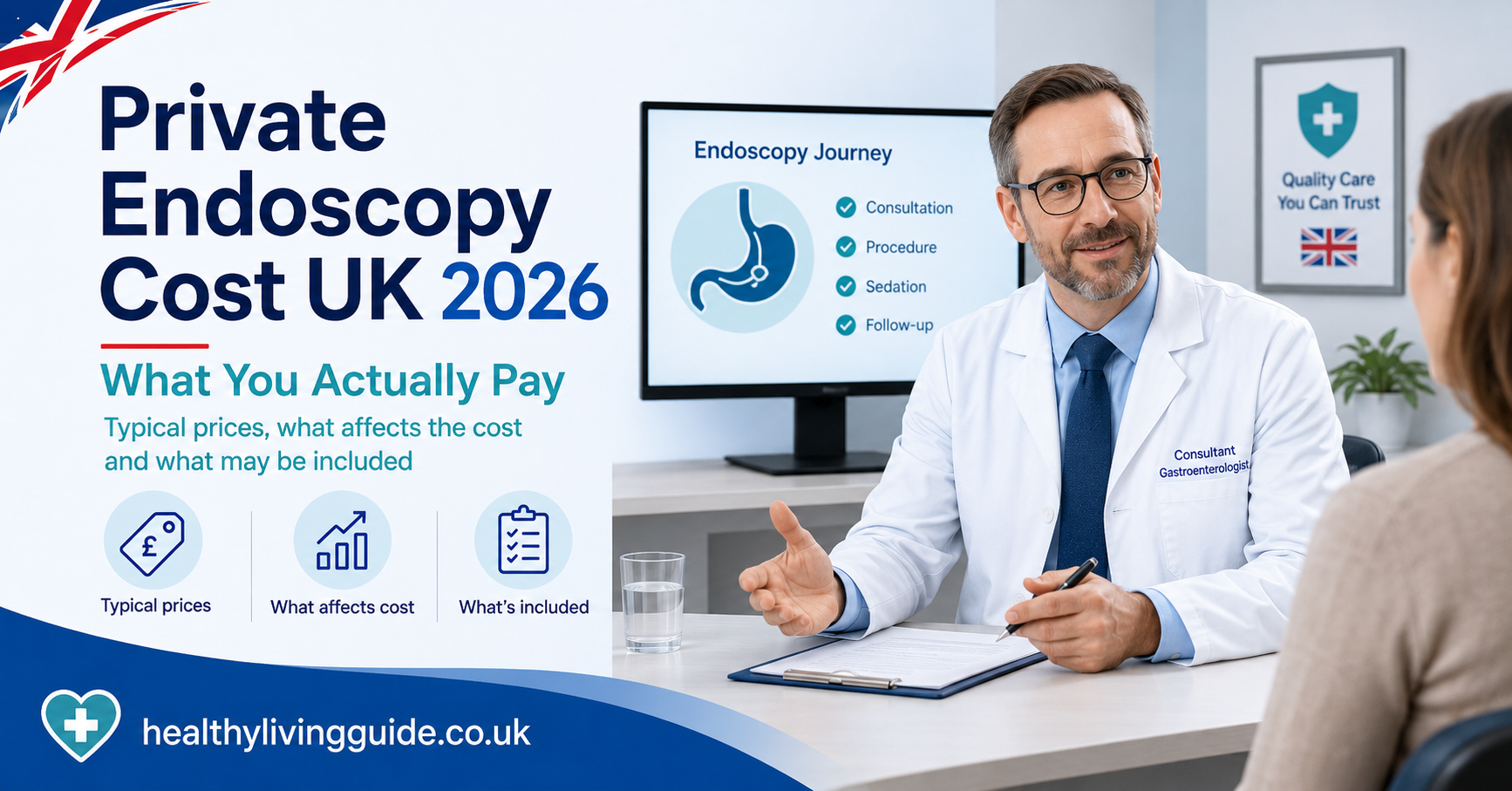
A private endoscopy in the UK can cost from around £1,000 to £2,500 or more, depending on the type of endoscopy, the hospital, the consultant, whether sedation is used, whether biopsies are taken, and what is included in the package.
For a private gastroscopy, which is also called an upper GI endoscopy, many people should expect to budget around £1,300 to £2,300 for a straightforward self-pay procedure, although some providers may quote lower or higher. If you need a consultation first, biopsies, lab testing, sedation, follow-up appointments or another test, the final amount can increase.
The difficult part is that private endoscopy prices are not always shown in the same way. One hospital may advertise a package price. Another may show the procedure price separately from the consultant fee. Another may include aftercare but not the initial consultation. This means the cheapest headline price is not always the cheapest final bill.
This guide explains what private endoscopy usually costs in the UK in 2026, what affects the price, what may be included, what can cost extra, and how to compare NHS and private routes safely.
Important medical disclaimer: This article is for general information only. It is not medical advice and should not be used to diagnose symptoms. If you have difficulty swallowing, vomiting blood, black stools, unexplained weight loss, persistent stomach pain, severe chest or abdominal pain, ongoing vomiting, anaemia, or symptoms that worry you, speak to your GP, NHS 111, or emergency services if urgent.
What Is An Endoscopy And Why Might You Need One?
An endoscopy is a medical procedure where a thin, flexible tube with a small camera is used to look inside part of the body. When people search for private endoscopy cost in the UK, they are often talking about a gastroscopy, also known as an upper gastrointestinal endoscopy.
A gastroscopy looks inside the upper part of the digestive system. This usually includes the oesophagus, which is the food pipe, the stomach, and the first part of the small intestine, called the duodenum.
The procedure may be recommended to investigate symptoms such as:
- Persistent indigestion
- Ongoing acid reflux or heartburn
- Difficulty swallowing
- Pain when swallowing
- Unexplained nausea or vomiting
- Vomiting blood
- Black or tarry stools
- Unexplained weight loss
- Unexplained iron-deficiency anaemia
- Suspected ulcers
- Suspected inflammation
- Monitoring conditions such as Barrett’s oesophagus
- Checking for coeliac disease or other digestive problems
A gastroscopy can help a specialist see whether there are signs of inflammation, ulcers, narrowing, bleeding, growths, or other changes in the upper digestive tract. During the test, small tissue samples called biopsies may be taken. These samples can be sent to a laboratory for further analysis.
Some people confuse gastroscopy, colonoscopy and general endoscopy. They are related, but they are not exactly the same.
A gastroscopy checks the upper digestive system through the mouth.
A colonoscopy checks the large bowel through the back passage.
A flexible sigmoidoscopy checks the lower part of the bowel.
A capsule endoscopy involves swallowing a small camera capsule that takes images as it travels through the digestive system.
This article mainly focuses on private gastroscopy or upper GI endoscopy, because that is what many people mean when they search for private endoscopy cost UK. However, some of the cost principles also apply to other types of endoscopy.
The most important point is that an endoscopy should be recommended for a clear medical reason. It is not just a casual health check. It is a medical test with benefits, preparation, possible discomfort, and small risks.
If you are worried about symptoms, especially symptoms that could suggest bleeding, cancer, ulcers or serious digestive disease, you should not simply shop around for private prices without speaking to a GP or appropriate clinician. A doctor can help decide whether an endoscopy is the right test or whether another investigation is more suitable.
How Much Does A Private Endoscopy Cost In The UK In 2026?
In 2026, a private endoscopy in the UK commonly costs around £1,000 to £2,500 or more, depending on the exact type of test and the provider.
For a straightforward private gastroscopy, a useful planning range is around £1,300 to £2,300. Some providers may advertise lower starting prices, while some hospital packages may be higher once consultation, sedation, biopsy, histology and follow-up are included.
Here is a simple guide to typical private endoscopy costs in the UK:
| Private endoscopy item | Typical UK cost range |
|---|---|
| Initial private consultation | £150 to £300+ |
| Private gastroscopy or upper GI endoscopy | £1,000 to £2,500+ |
| Common planning range for self-pay gastroscopy | £1,300 to £2,300 |
| Sedation | Sometimes included, sometimes extra |
| Biopsy or tissue samples | Sometimes included, sometimes extra |
| Histology or lab testing | Sometimes included, sometimes extra |
| Follow-up appointment | Sometimes included, sometimes extra |
| Combined gastroscopy and colonoscopy | Usually more expensive |
The exact price depends on what the provider includes in the package.
For example, one hospital may quote a treatment price and then add the initial consultant appointment separately. Another may give a single guide price that includes the main procedure and aftercare. Another may charge extra if biopsies are taken or if histology is needed.
This is why you should always ask for a written quote before booking.
A private endoscopy quote may include:
- The hospital facility fee
- The consultant or endoscopist fee
- Nursing care
- Use of the endoscopy room
- Throat spray or sedation
- Recovery room time
- A written report
- Aftercare advice
However, it may not include:
- The first consultation
- Biopsies
- Lab testing
- Follow-up consultation
- Additional medication
- Further scans or blood tests
- Treatment if something abnormal is found
- Repeat procedure if the test cannot be completed
The price can also vary by location. London and some large cities can be more expensive. A private hospital in central London may charge more than a provider outside London. Consultant fees can also vary.
If you are using private medical insurance, the price you personally pay may depend on your excess, policy terms, pre-authorisation, hospital list, consultant choice and whether the condition is covered. Do not assume that insurance will automatically pay for the test. Always check before booking.
If you are paying yourself, ask one simple question:
“What is the maximum I could pay if biopsies are taken or extra lab tests are needed?”
This question matters because a low headline price may not include everything that happens during the test.
What Is Usually Included In A Private Endoscopy Package?
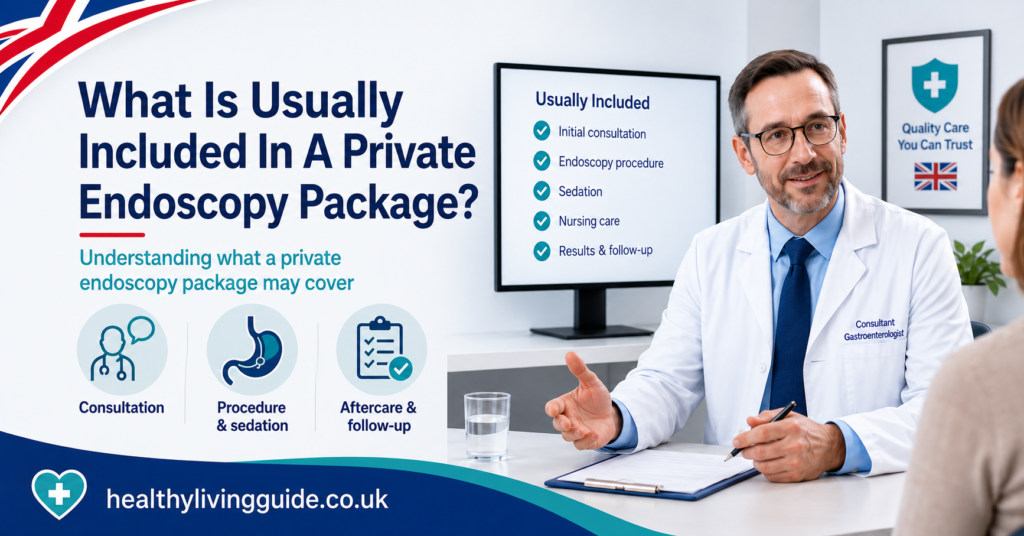
A private endoscopy package can include different things depending on the hospital, clinic and consultant. Some packages are more complete than others, so it is important to check the details.
A typical private endoscopy pathway may start with a consultation. During this appointment, the consultant will ask about your symptoms, how long they have been happening, your medical history, medication, previous investigations and family history. They may ask about reflux, swallowing problems, weight loss, vomiting, bleeding, appetite changes, alcohol use, smoking, pain, anaemia and other symptoms.
This appointment matters because an endoscopy is not always the first or only test. Some people may need blood tests, stool tests, a breath test for Helicobacter pylori, an ultrasound, a CT scan, a barium swallow, or referral through an urgent NHS pathway. Others may need medication first or a different investigation.
If endoscopy is recommended, the hospital will usually give you instructions before the procedure. For gastroscopy, you normally need to stop eating for several hours before the test. This is because the stomach needs to be empty so the specialist can see clearly and reduce the risk of vomiting during the procedure.
On the day, you may have basic checks such as blood pressure, pulse and medical history questions. You may be asked about allergies, medication, blood thinners, diabetes, heart or lung conditions, previous reactions to sedation and whether someone can take you home afterwards.
A gastroscopy is usually done as a day-case or outpatient procedure. A thin flexible tube is passed through the mouth and down into the upper digestive system. The specialist may use a local anaesthetic throat spray, sedation, or sometimes both, depending on the provider and your suitability.
During the test, the specialist can look at the lining of the oesophagus, stomach and duodenum. If needed, they may take biopsies. These are small tissue samples and are usually painless. Biopsies may be taken to check for inflammation, infection, coeliac disease, Barrett’s oesophagus, ulcers, abnormal cells or other issues.
After the test, you will spend time recovering. If you have sedation, you will usually need someone to take you home. You should not drive, drink alcohol, operate machinery or make important decisions for the period advised by your clinical team.
A private endoscopy package may include a written report. The consultant may explain early findings on the day. If biopsies are taken, final lab results may take longer. Some packages include a follow-up appointment, while others charge for this separately.
Here are the items you should check before booking:
| Item | Ask whether it is included |
| Initial consultation | Is it included or separate? |
| Procedure fee | Is this the full hospital and consultant fee? |
| Sedation or throat spray | Is comfort care included? |
| Biopsies | Are tissue samples included if needed? |
| Histology | Is lab analysis included? |
| Written report | Will you receive a copy? |
| Follow-up | Is a follow-up consultation included? |
| Further care | What happens if treatment is needed? |
The safest approach is to avoid assumptions. Ask for the full details in writing.
What Can Make The Final Price Higher?
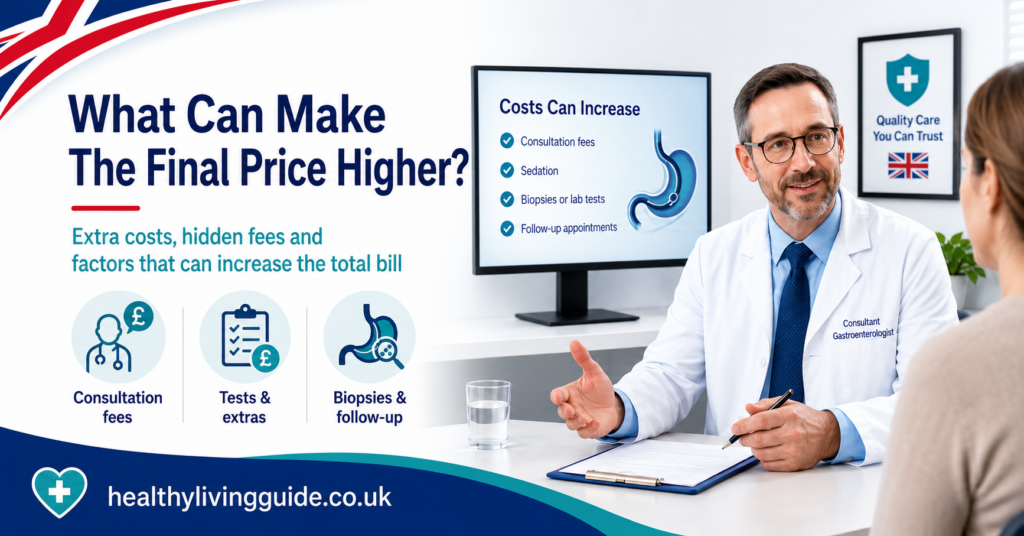
The final price of a private endoscopy can increase for several reasons.
The first reason is the initial consultation. Some providers list the endoscopy treatment price separately from the consultant appointment. If the consultation is not included, you may need to add around £150 to £300 or more to the total cost.
The second reason is sedation. Some people have throat spray only. Others have sedation. Some providers include sedation in the package, while others may charge extra depending on the type used and whether additional anaesthetic support is needed.
The third reason is biopsies. During a gastroscopy, the consultant may decide to take tissue samples. This is often clinically useful, but it may increase the cost if biopsy and lab analysis are not included.
The fourth reason is histology. Histology is the laboratory examination of tissue samples. Even if the biopsy itself is simple, the lab analysis may be billed separately.
The fifth reason is follow-up. If the result needs explanation, medication changes, further tests or referral for treatment, you may need another appointment. Some providers include one follow-up appointment, while others charge separately.
The sixth reason is combined procedures. Some people have a gastroscopy and colonoscopy on the same day. This may be recommended if symptoms or test results suggest the need to examine both the upper and lower digestive tract. Combined procedures cost more than a simple gastroscopy.
The seventh reason is location. Private healthcare pricing varies across the UK. London and some major city hospitals may be more expensive than hospitals in other regions.
The eighth reason is consultant choice. Consultants are independent in many private hospitals and may set their own fees. A specific specialist may charge more than another consultant.
The ninth reason is complexity. If you have other health conditions, take certain medication, need extra monitoring, or require a different pathway, the final cost may change.
The tenth reason is further investigations. If the endoscopy shows something abnormal, you may need blood tests, scans, medication, repeat endoscopy, referral to another specialist, or treatment. These may not be part of the original quote.
Before booking, ask these exact questions:
- Does the quote include the consultation?
- Does it include the hospital fee and consultant fee?
- Does it include sedation or throat spray?
- Does it include biopsies if needed?
- Does it include histology or lab testing?
- Does it include a written report?
- Does it include follow-up?
- What happens if something abnormal is found?
- Could I be charged more on the day?
- What is the maximum likely total cost?
The more clearly you ask, the less likely you are to be surprised later.
NHS Vs Private Endoscopy Which Route Makes Sense?
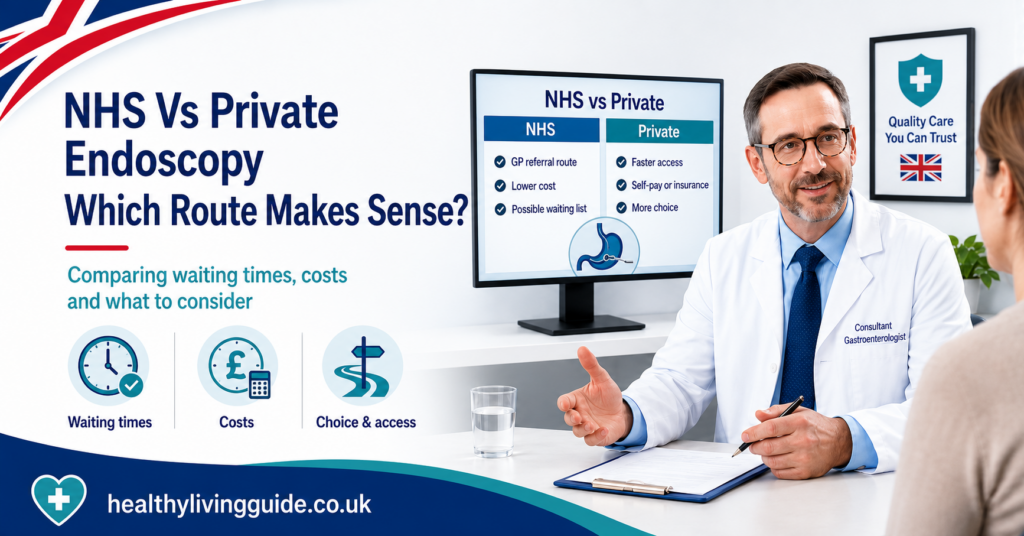
For many people in the UK, the NHS is the best and safest first route for digestive symptoms. Your GP can assess your symptoms, decide whether an endoscopy is needed, and refer you through the correct pathway.
This is especially important if your symptoms could suggest something serious. Symptoms such as difficulty swallowing, vomiting blood, black stools, unexplained weight loss, persistent vomiting, anaemia or severe pain should be discussed with a doctor promptly.
The NHS route may make sense if:
- Your symptoms meet urgent referral criteria
- You cannot afford private care
- You prefer treatment through your GP and local hospital
- You need ongoing NHS follow-up
- You have complex medical needs
- You are unsure what test you need
A private endoscopy may make sense if:
- You want faster access
- You have private medical insurance
- You want more choice over appointment timing
- You want to choose a hospital or consultant
- Your symptoms are worrying but not being treated as urgent
- You are comfortable paying self-pay costs
- You understand what is and is not included
Private care can be useful, but it is not always automatically better. It mainly gives faster access and more choice. The clinical decision still needs to be appropriate.
You should also be careful about booking private endoscopy purely for reassurance. If you have no clear symptoms or risk factors, a doctor may advise that another approach is more suitable. All medical procedures have benefits and risks, so the test should have a clear purpose.
If you use private care and the results show a problem that needs treatment, ask how the pathway will continue. Some people continue privately. Some return to the NHS. Some use insurance. Some need urgent referral. It is better to understand this before the test rather than after receiving worrying results.
For self-pay patients, the most practical question is:
“Am I only paying for the test, or am I prepared to pay for the follow-up care if the test finds something?”
This matters because diagnosis is only one part of the journey. Treatment and follow-up can cost more.
How To Prepare For An Endoscopy And What Happens On The Day
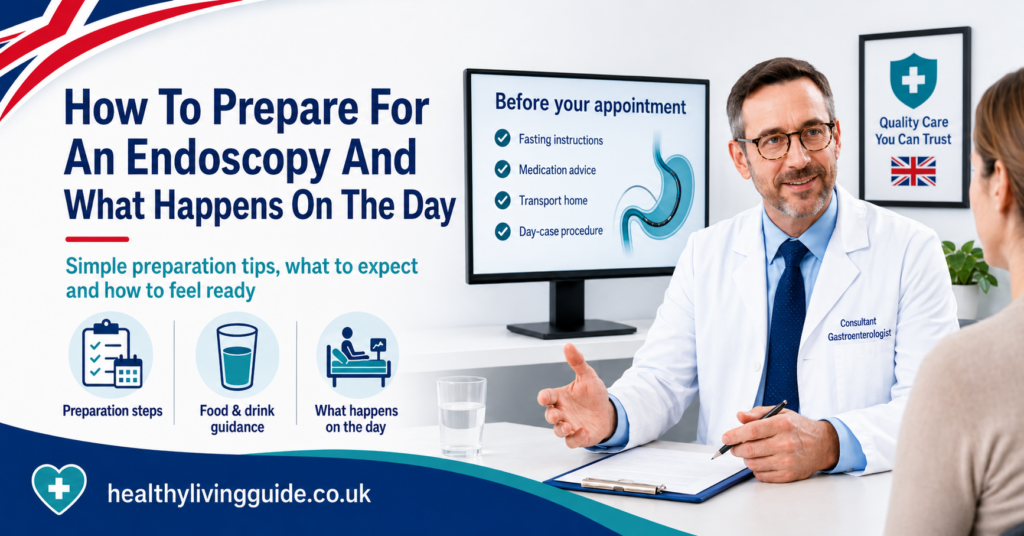
Preparation depends on the type of endoscopy. For a gastroscopy, the main preparation is usually fasting. The stomach needs to be empty so the specialist can see clearly and reduce risk during the procedure.
Your hospital will give you specific instructions, and you should follow them carefully. Do not rely only on general advice online because instructions can vary depending on your health, medication and appointment time.
You may be told to stop eating at least 6 hours before the test. You may be allowed small sips of water up to a certain time. You may need to stop or adjust some medication, but only do this if the clinical team tells you to.
Tell the hospital if you:
- Take blood thinners
- Have diabetes
- Have heart or lung disease
- Have swallowing problems
- Have allergies
- Are pregnant or may be pregnant
- Have had problems with sedation before
- Have loose teeth, crowns, bridges or dentures
- Have a pacemaker or implanted medical device
- Have kidney disease or other major health conditions
On the day, you will usually arrive at the hospital or clinic and check in. A nurse may confirm your details, ask about your medical history, check your observations and explain what will happen.
You may be offered throat spray, sedation, or both. Throat spray numbs the throat and can make the procedure easier. Sedation can make you feel relaxed and sleepy, but it is not usually the same as a full general anaesthetic.
If you have sedation, you will usually need someone to collect you and stay with you afterwards. You should not drive yourself home.
During the gastroscopy, you will usually lie on your side. A small mouth guard may be used to protect your teeth and the endoscope. The tube is passed through the mouth and down into the upper digestive tract. You may feel pressure, gagging or discomfort, but the procedure is usually fairly quick.
The specialist may take biopsies if needed. You should not feel pain from the biopsy itself.
After the procedure, you will rest in recovery. If you had throat spray, you may need to wait until your swallowing returns to normal before eating or drinking. If you had sedation, you will need longer monitoring and should follow the discharge advice carefully.
You may have a sore throat, bloating or mild discomfort afterwards. This usually settles. However, you should seek urgent medical help if you develop severe chest pain, severe abdominal pain, vomiting blood, black stools, difficulty breathing, fever, fainting, or symptoms that feel serious.
The hospital should give you clear aftercare instructions and tell you when to expect results.
Questions To Ask Before Booking And Final Thoughts
Before booking a private endoscopy, it is worth slowing down and asking the right questions. This can protect your health, your money and your expectations.
Here are the key questions to ask.
Do I definitely need this test?
Ask the consultant why endoscopy is recommended and what they are trying to rule in or rule out. Also ask whether any other tests should be done first.
Is this a gastroscopy, colonoscopy, sigmoidoscopy or another type of endoscopy?
The word endoscopy can mean different procedures. Make sure you know exactly what you are booking.
What is included in the price?
Ask whether the price includes consultation, hospital fee, consultant fee, sedation, biopsies, histology, written report and follow-up.
What could cost extra?
Ask specifically about biopsy, lab testing, medication, follow-up appointments and further investigations.
Who will perform the procedure?
Ask whether it will be a consultant gastroenterologist, surgeon, trained endoscopist or another specialist.
What are the risks?
Ask about discomfort, sore throat, bleeding, perforation, sedation risks, aspiration risk and what to do if you feel unwell afterwards.
What are my comfort options?
Ask whether you can have throat spray, sedation, gas and air, or another approach. Also ask what recovery rules apply.
How quickly will I get results?
Some findings may be discussed on the day. Biopsy results may take longer. Ask how you will receive the report.
What happens if something is found?
Ask whether you continue privately, return to your GP, get referred to the NHS, or need further private treatment.
Is the provider regulated?
Check that the hospital or clinic is properly regulated and that you feel confident in the information provided.
FAQ
How much does a private endoscopy cost in the UK?
A private endoscopy in the UK commonly costs around £1,000 to £2,500 or more. For a private gastroscopy, many people should budget around £1,300 to £2,300, but the final cost depends on provider, location, consultation fees, sedation, biopsies and follow-up.
Is a gastroscopy the same as an endoscopy?
A gastroscopy is a type of endoscopy. It looks at the upper digestive system, including the oesophagus, stomach and first part of the small intestine. People often use the word endoscopy when they mean gastroscopy.
Can I get a private endoscopy without a GP referral?
Some private providers may allow self-referral, but others may require a GP or consultant referral. Even if self-referral is possible, it is sensible to speak to a GP or doctor first so the right test is chosen.
Is private endoscopy painful?
A gastroscopy can be uncomfortable, especially because the tube passes through the throat. Throat spray and sedation can make it easier. Many people tolerate the procedure well, but you should discuss comfort options before booking.
How long does a private endoscopy take?
The procedure itself may be quite short, often around 10 to 20 minutes for gastroscopy, but your total appointment time will be longer because of admission, preparation, recovery and discharge.
Will I be asleep during an endoscopy?
Usually, gastroscopy is done with throat spray, sedation, or both. Sedation makes you relaxed and sleepy, but it is not always the same as a general anaesthetic. Ask your provider what they offer.
Can biopsies be taken during an endoscopy?
Yes, biopsies can be taken during a gastroscopy if needed. These are small tissue samples sent to a lab. Ask whether biopsy and histology costs are included in your quote.
Can I drive after a private endoscopy?
If you have sedation, you should not drive afterwards and will need someone to take you home. Follow the exact instructions given by your clinical team.
What symptoms should I not ignore?
Do not ignore difficulty swallowing, vomiting blood, black stools, unexplained weight loss, persistent vomiting, severe pain, anaemia or symptoms that feel urgent. Speak to your GP, NHS 111 or emergency services depending on severity.
Final Thoughts
A private endoscopy can be useful if you want quicker access, more appointment choice or private care through insurance. But the price can vary a lot, and the headline figure does not always show the full cost.
In 2026, a private gastroscopy in the UK may cost around £1,000 to £2,500 or more, with many self-pay patients needing to budget around £1,300 to £2,300 for a straightforward procedure. The final price can increase if the consultation, sedation, biopsies, lab testing or follow-up are charged separately.
Before booking, make sure the test is clinically appropriate, ask what is included, get the quote in writing, and understand what happens if the endoscopy finds something.
Your health comes first. The right test, with the right explanation and the right follow-up, matters more than simply finding the lowest advertised price.t follow-up, matters more than simply finding the lowest advertised price.
Important Medical Disclaimer
This article is for general information only and should not be taken as medical advice, diagnosis or treatment. Private endoscopy prices can change and may vary by hospital, consultant, location, package and individual medical needs. Always confirm the latest costs directly with the provider before booking. If you have symptoms such as difficulty swallowing, vomiting blood, black stools, unexplained weight loss, severe pain or symptoms that worry you, speak to your GP, NHS 111 or emergency services if urgent.