
Walking is one of the simplest forms of exercise. You do not need a gym membership, expensive equipment, complicated routines or advanced fitness knowledge. You put on a pair of shoes, step outside and move your body forward. Because of that simplicity, walking can sometimes be underestimated. It feels too basic to be powerful. But when walking is pushed to an extreme, it quickly becomes clear that every step is still physical work.
The idea behind walking 250,000 steps in one week sounds almost unbelievable at first. That works out at roughly 35,700 steps per day. For most people, that is not a normal active lifestyle. That is hours and hours of walking every single day, repeated for seven days, with very little room for poor planning, bad weather, sore feet or tiredness. In the transcript used for this article, the challenge involved daily weigh-ins, body measurements, long outdoor walks, tired legs, blisters, swollen ankles, changes in appetite, strength training and a final reflection on whether such an extreme step count is worth attempting.
The short answer is that walking more can be excellent for health, but walking 250,000 steps in a week is not a sensible target for most people. The NHS describes walking as simple, free and one of the easiest ways to become more active, lose weight and improve fitness, and even a brisk 10-minute daily walk can count towards weekly activity goals. However, there is a big difference between using walking as a healthy daily habit and suddenly forcing your body through marathon-level walking volume every day.
This article explains what can happen to your body when you walk 250,000 steps in a week, why the body can adapt surprisingly quickly, why your feet and joints may suffer before your fitness gives up, and how ordinary people can use walking safely without copying the extreme version of the challenge.
What The 250,000 Step Challenge Actually Means
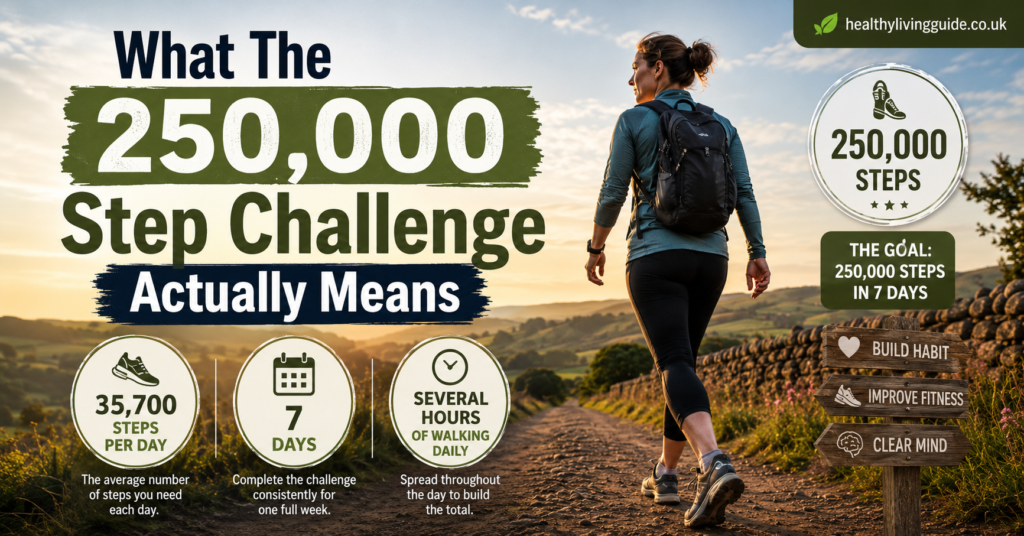
A challenge like this sounds simple because the instruction is simple. Walk 250,000 steps in seven days. But once you break the numbers down, the scale becomes much clearer.
A daily average of around 35,700 steps is far beyond what many people do in normal life. Depending on stride length, walking pace, terrain and height, that could mean several hours of walking each day. In the transcript, the walker often split the day into long morning and afternoon walks. On some days, the morning walk alone lasted three, four, five or even six hours. The challenge was not just about fitness. It was about time, planning, weather, footwear, food, recovery and pain management.
This is important because people often look at step counts as if all steps are equal. They are not. Ten thousand steps during a normal day with breaks, errands and gentle movement feels very different from 35,000 steps achieved through long, continuous walks. Steps on soft ground feel different from steps on concrete. Steps in good shoes feel different from steps in wet socks or unsupportive footwear. Steps taken when fresh feel different from steps taken when your heels are already sore.
The body also does not experience a weekly total as one neat number. It experiences each day separately. If you walk 35,000 steps on Monday, you wake up on Tuesday with Monday’s fatigue still in your legs and feet. If you do it again on Tuesday, Wednesday begins with two days of stress already built up. By the middle of the week, the challenge becomes less about whether you have the cardiovascular fitness to keep moving and more about whether your feet, ankles, skin and joints can tolerate the repeated impact.
That is one of the most interesting lessons from the challenge. The walker did not mainly fail because of breathlessness or lack of motivation. The major limiting factor became foot pain, heel soreness, blisters, ankle swelling and general joint discomfort. This shows something important about extreme walking. Walking is lower impact than running, but it is not impact-free. Repetition matters. A single step is easy. A quarter of a million steps in one week is a huge amount of repeated loading.
For comparison, official health guidance is much more moderate. The NHS recommends that adults aged 19 to 64 do at least 150 minutes of moderate intensity activity each week, or 75 minutes of vigorous intensity activity, along with strengthening activities on at least two days a week. That does not mean more activity is always bad, but it does mean that 250,000 steps is not required for basic health benefits. It is an extreme experiment, not a normal target.
The challenge also highlights the hidden logistics of high step counts. You need enough daylight. You need suitable clothing. You need dry socks. You need shoes that fit properly. You need food that supports recovery. You need time to stretch, wash, rest and sleep. You need a plan for bad weather. You need to know when pain is normal discomfort and when it may be a warning sign.
For someone with a job, family responsibilities, health issues or limited spare time, 35,000 steps every day may be unrealistic and unnecessary. But as a physical experiment, it gives us a useful window into how the body reacts when walking volume is suddenly pushed far beyond normal.
How Your Heart Lungs And Energy System Respond
One of the first systems to respond to a major walking challenge is your cardiovascular system. Your heart, lungs and blood vessels all have to support the increased demand for movement. Even though walking is usually moderate rather than intense, doing it for hours means your body needs a steady supply of oxygen and energy.
During long walks, your heart rate rises above resting level. Your breathing becomes deeper. Blood flow increases to the working muscles in your legs and hips. Your body uses a mixture of stored carbohydrate and fat to keep you moving. At an easy or moderate pace, walking is often sustainable for a long time because it does not usually push you into the same level of breathlessness as running.
This is one reason walking can be so useful for health. It is accessible, repeatable and less intimidating than many other forms of exercise. The NHS notes that brisk walking can help build stamina, burn excess calories and make the heart healthier. The World Health Organization also recommends that adults do at least 150 minutes of moderate intensity physical activity per week, and states that both moderate and vigorous activity improve health.
However, there is a difference between building up gradually and suddenly doing an extreme week. In the transcript, the first day felt manageable at first. The walker even described walking as simply putting one step in front of the other. But by day two and day three, the effort changed. The cardiovascular system may have coped, but the body as a whole was carrying fatigue.
Interestingly, by the middle of the week, the walker felt that the body had started to adapt. Waking early and walking for hours became part of the routine. This shows how quickly the human body can adjust to repeated behaviour. When you do something daily, your brain and body begin to treat it as normal. The first early morning walk feels unusual. By day six, getting up and walking long distances can feel almost automatic.
This does not mean the body has fully recovered or become immune to injury. Adaptation and damage can happen at the same time. You can feel mentally stronger while your feet are becoming more inflamed. You can feel fitter while blisters are forming. You can feel energised while your ankles are swelling. That is why extreme challenges can be misleading. Feeling capable does not always mean your tissues are recovering properly.
The energy system also has to keep up. Long walks increase calorie expenditure, but appetite may not always rise in a predictable way. In the transcript, appetite appeared to reduce as the week went on, which can happen during periods of high exertion, stress, disrupted routine or fatigue. Some people become hungrier when they increase activity, while others temporarily lose appetite. Neither response should be ignored. If you dramatically increase your walking but under-eat, you may increase fatigue, reduce recovery and risk losing muscle as well as fat.
This is where walking differs from a short workout. A 45-minute gym session is intense but contained. A five-hour walk spreads the demand across a large part of the day. Your body is not just exercising. It is managing temperature, hydration, blood sugar, posture, joint loading and repeated muscular contraction for hours.
For most people, the best lesson is not to walk 35,000 steps a day. The lesson is that the heart and lungs respond well to regular movement, and walking is one of the easiest ways to give them that stimulus. A safer approach is to build a walking habit that can be repeated for months and years, not just survived for one extreme week.
Calories Weight Loss And Body Measurements
One of the biggest reasons people become interested in step challenges is weight loss. Walking burns calories, and a very high step count can create a significant energy demand. But the relationship between walking, body weight and fat loss is not as simple as many people think.
In the challenge, the walker weighed himself daily and took body measurements before and after the week. By the end, he was around 2 lb lighter, and some body measurements appeared slightly smaller. There was also a visual impression of looking narrower, especially around the lower belly. That makes sense on the surface. More walking means more calories burned, and if food intake does not fully replace that energy, body weight may fall.
But scale weight can change for many reasons. Fat loss is only one part of the picture. Water balance, muscle glycogen, salt intake, bowel contents, inflammation and muscle soreness can all affect weight. After a huge amount of walking, your body may hold extra fluid around stressed tissues. This can temporarily hide fat loss on the scale. In the transcript, weight did not fall in a straight line. On some days, the walker was heavier despite doing many hours of walking. That is completely normal.
This is why daily weigh-ins can be confusing. A person might walk more, eat well and still see the scale go up the next morning because the body is inflamed or holding water. Another person might see a fast drop that is mostly water, not pure fat. A single week is too short to judge long-term fat loss accurately.
Body measurements can be useful, but they also have limits. Measuring tape placement can vary slightly. Posture can change. Hydration can change. Muscle fullness can change. After an extreme walking week, the thighs or calves may look different because of temporary swelling, muscle pump or inflammation, not just new muscle growth or fat reduction.
Still, there is no doubt that walking can support weight management when done consistently. The key word is consistently. A person who walks briskly most days, controls food intake and builds strength over time is likely to get better long-term results than someone who does one brutal week, injures their feet and then stops moving for a month.
The NHS physical activity guidance encourages adults to spread exercise evenly over four to five days a week or every day, reduce long periods of sitting and include strengthening activities. This balanced approach is far more realistic for fat loss and health than attempting a sudden quarter-million-step challenge.
Another important point is that walking can increase hunger for some people. If someone burns hundreds of extra calories but then eats much more without realising it, weight loss may be smaller than expected. On the other hand, if someone eats too little while doing very high steps, they may feel tired, irritable and more prone to injury. The goal should not be to punish the body into weight loss. The goal should be to create a sustainable energy balance.
For fat loss, walking works best when paired with simple nutrition habits. That means eating enough protein, drinking enough water, having regular meals, including fruit and vegetables, and not using walking as an excuse to binge on ultra-processed foods. It also means understanding that fat loss takes time. One extreme week may create visible changes, but the real transformation comes from months of repeatable behaviour.
The 250,000-step challenge shows that the body can change quickly, but it also shows that extreme effort comes with a cost. A smaller daily walking habit may not look as dramatic on video, but it is usually far better for real life.
Feet Ankles Blisters And Joint Pain
The clearest downside of the challenge was not lack of motivation. It was the damage to the feet and ankles.
This is one of the most important lessons for anyone increasing their walking. Your heart may be ready before your feet are ready. Your mind may be motivated before your joints are conditioned. Your lungs may cope before your skin can handle the friction.
In the transcript, the first warning signs appeared early. Wet socks, sore heels and the need for better footwear came up on day one. As the week continued, the discomfort became more serious. There were aching feet, heel pain, blisters, swollen ankles and eventually even a black toenail after the challenge. These are not small details. They are the body’s way of showing that tissues are being overloaded.
Blisters are especially common during long walks because of friction, heat and moisture. The NHS advises getting help from NHS 111 if a blister is very painful, keeps coming back, shows signs of infection, appears in an unusual place, or if several blisters appear for no clear reason. NHS Inform also notes that most blisters heal naturally within 3 to 7 days and advises avoiding bursting them because this can increase infection risk.
Footwear matters enormously. Shoes or boots that feel fine for a short walk may become painful after several hours. A small rub can become a blister. A slightly tight toe box can lead to bruised toenails. Boots that protect against wet ground may also create pressure around the heel or ankle. Crocs or softer shoes may reduce one type of pain but increase another risk because they offer less support. This is exactly the kind of trade-off that appears during extreme walking.
Socks are also important. Wet socks increase friction. Cotton socks may hold moisture. Walking socks with better cushioning and moisture control can make a major difference. Changing socks during a very long walk may help. So can using blister plasters or protective tape before hot spots become open wounds.
The ankles and joints face a different problem. Every step loads the foot, ankle, knee and hip. Walking is usually gentle compared with running, but 250,000 steps is still a huge number of repetitions. If the muscles around the joints become tired, more stress can shift to tendons, ligaments and joint surfaces. If terrain is uneven, the ankles work even harder. Hills add extra strain, especially when the body is already tired.
This is why pain should be taken seriously. Mild muscle tiredness is expected when activity increases. Sharp pain, worsening joint pain, swelling, limping, numbness or pain that changes your walking pattern should not be ignored. In the transcript, heel pain began to affect walking style. That matters because once you change your gait to avoid pain, you may place stress somewhere else.
A sensible walking plan should include gradual progression. If you normally do 4,000 steps a day, jumping to 20,000 or 30,000 is a big shock. A better approach might be to add 1,000 to 2,000 steps per day for a week or two, see how your body responds, then increase again if comfortable. Your feet need time to toughen up. Your tendons need time to adapt. Your calves, hips and lower back need time to support the extra movement.
Recovery is not weakness. It is part of training. Rest days, easier days, stretching, sleep, hydration and proper footwear can make walking sustainable. Without them, walking can go from healthy habit to overuse injury.
The main message is simple. Walking is good for you, but pain is information. Listen early, adjust early and do not wait until your feet force you to stop.
Protein Strength Training And Muscle Preservation
One of the smarter parts of the challenge was the focus on protein and strength training. When people think about walking for weight loss, they often only think about calories. But body composition matters more than scale weight alone. Losing fat is useful. Losing muscle is not.
During a week of very high walking volume, the body needs energy. If calorie intake is too low and protein intake is poor, the body may not recover well. Over time, aggressive dieting combined with lots of activity can increase the risk of muscle loss. That is why the walker aimed for a higher protein intake and included some strength training during the challenge.
Protein supports muscle repair and helps with fullness. It is especially important during weight loss because it can help preserve lean mass. This does not mean everyone needs to copy a specific number of grams from a video. Protein needs vary depending on body weight, age, activity level, health status and goals. But the principle is sound. If you are increasing exercise and trying to lose fat, do not neglect protein.
Strength training is also important because walking alone does not train every major muscle group fully. Walking works the calves, thighs, glutes and postural muscles, but it does not replace resistance training for the upper body, back, chest, shoulders and arms. This is why official guidelines include strengthening activities as well as aerobic exercise. The NHS recommends strengthening activities for all major muscle groups on at least two days per week. The CDC gives similar guidance, recommending 150 minutes of moderate-intensity activity plus two days of muscle-strengthening activity per week for adults.
For ordinary people, this is a very useful lesson. Walking is excellent, but it should not be the only form of movement if your goal is long-term health, strength and ageing well. A balanced routine might include daily walking, two short strength sessions per week, mobility work and enough rest.
The challenge also raises an important point about appetite. The walker noticed a weaker appetite as the week went on, even though the activity level was very high. This can happen, but it can be risky if it leads to under-fuelling. If you are walking a lot and your appetite drops, it is still important to eat enough to recover. Signs that you may not be fuelling well include dizziness, unusual fatigue, poor sleep, irritability, headaches, feeling cold, poor performance and slow recovery.
For a healthier version of a walking-based fat loss plan, meals do not need to be complicated. A good structure might include protein at each meal, slow-release carbohydrates for energy, healthy fats, and plenty of fluids. Examples include eggs with wholegrain toast, Greek yoghurt with fruit, chicken or lentil curry with rice, tuna or chickpea salad, porridge with milk, or a simple homemade soup with beans and vegetables.
Strength training does not need to be extreme either. Bodyweight squats, press-ups against a wall, resistance band rows, dumbbell shoulder presses, lunges, step-ups and planks can all be useful. For beginners, two 20 to 30-minute sessions per week can make a real difference.
The most important point is that the goal should be better health, not simply a lower number on the scale. Walking can help reduce body fat, but strength training helps protect the body you are trying to improve. A lighter body is not always a healthier body if the weight loss comes with weakness, injury and exhaustion.
Mental Health Routine And The Outdoor Effect
One of the most positive parts of the 250,000-step challenge was the mental shift. At the beginning, the routine felt unusual and difficult. Getting up early and walking immediately was a major change. But after several days, the walker described the new routine as normal. This shows how quickly behaviour can reshape identity.
Walking has a powerful psychological advantage because it is simple. You do not have to psych yourself up for a complicated workout. You do not have to perform in front of anyone. You do not have to compete. You just walk. That simplicity makes it easier to start, especially for people who feel overwhelmed by fitness culture.
The outdoor element also matters. In the transcript, the walker explored new footpaths, woodland, fields, lakes, wildlife and quiet morning routes. Even though the weather was often grey and British, the outdoor experience became part of the reward. There were moments of fog, birds, deer, cows, lakes and finally sunshine. That may sound small, but it is one reason walking can become addictive in a healthy way. It connects movement with fresh air, curiosity and a sense of progress.
For many people, walking is not just exercise. It is thinking time. It is stress relief. It is a break from screens. It is a way to process emotions. It can be done alone, with family, with a friend or with a dog. It can be used during lunch breaks, after dinner, before work or on days off.
There is also a confidence effect. Completing a difficult walk gives a sense of achievement. Completing several days in a row builds discipline. The walker began with uncertainty and ended with a strong sense of accomplishment. That feeling can be valuable. When someone proves to themselves that they can do hard things, it can carry over into other areas of life.
However, there is a danger here too. Mental toughness should not become self-punishment. It is good to challenge yourself, but not every challenge is wise. If you push through serious pain just to hit a number, you may win the challenge and lose your ability to walk comfortably for weeks. A step goal should support your life, not control it.
A healthier mindset is to use walking as a daily anchor. Instead of asking, “How can I force myself to do the most steps possible?” ask, “What amount of walking helps me feel better and still recover?” For one person, that might be 7,000 steps. For another, it might be 12,000. For someone already fit, 15,000 or 20,000 may be manageable. The right number depends on your current fitness, body weight, job, sleep, footwear, age, injury history and available time.
The NHS encourages people to reduce time spent sitting or lying down and break up long periods of not moving with some activity. That is a powerful message because it means movement does not have to be extreme to matter. A 10-minute walk after meals, a walk to the shops, stairs instead of lifts, a lunchtime loop around the block, and a longer weekend walk can all add up.
The outdoor effect may be one of the biggest reasons walking is easier to maintain than many exercise plans. When you enjoy the route, the scenery and the feeling afterwards, the habit becomes less about discipline and more about lifestyle.
A Safer Way To Get The Benefits Without Going Extreme

So, should you try walking 250,000 steps in a week?
For most people, no. It is an impressive challenge, but it is not necessary for health and may create avoidable injuries. The walker in the transcript finished the challenge, but also ended with painful feet, blisters, swollen ankles and a black toenail afterwards. That is a high price to pay for one week of content or curiosity.
A much better approach is to take the lesson from the challenge and apply it safely. The lesson is not that everyone should walk 35,000 steps a day. The lesson is that walking is powerful, the body adapts quickly, consistency matters, and small daily movement can produce real benefits.
If you are currently inactive, start small. A brisk 10-minute daily walk is a realistic beginning and is recognised by the NHS as a useful contribution towards weekly activity. Once that feels easy, increase gradually. You might aim for 20 minutes a day, then 30 minutes, then longer walks on days when you have more time.
If you like step goals, choose one that matches your life. There is nothing magical about 10,000 steps. It can be useful, but it is not the only valid target. Someone doing 3,000 steps a day may benefit from aiming for 5,000. Someone already doing 8,000 may aim for 10,000 or 12,000. Someone with an active job may not need extra steps at all and may benefit more from strength training and recovery.
A sensible walking progression could look like this. First, find your normal average step count for a week. Then add a small amount, such as 1,000 extra steps per day. Stay there for one or two weeks. If your feet, knees and hips feel fine, increase again. If pain appears, reduce the volume and check your footwear, route and recovery.
Good shoes are essential. Choose footwear that fits well, supports your feet and suits the terrain. Do not attempt long walks in brand-new shoes without testing them first. Wear comfortable socks. Keep your feet dry where possible. Treat hot spots early before they become blisters. If you develop a blister, protect it and avoid bursting it. Seek advice if it becomes very painful, infected or keeps returning.
Include strength work at least twice a week. This helps your muscles, joints and bones cope better with walking. You do not need to become a bodybuilder. You just need enough resistance training to maintain strength. Squats, step-ups, hip hinges, calf raises, rows and presses can all support a walking routine.
Do not ignore recovery. Sleep matters. Food matters. Hydration matters. Easier days matter. If your ankles are swollen, your heel pain is worsening, or you are limping, more steps are not the answer. Rest, reduce the load and seek professional advice if symptoms do not settle.
For people with medical conditions, previous injuries, diabetes, poor circulation, heart problems or major joint pain, it is sensible to speak to a GP, physiotherapist or other qualified health professional before attempting a major increase in activity. General walking is safe for many people, but extreme volume is different.
The best walking plan is the one you can repeat. It should make you healthier, not leave you unable to move. It should improve your energy, not drain your life. It should fit around your work, family and sleep. It should be challenging enough to create progress but gentle enough to continue.
Walking 250,000 steps in a week shows what the human body can tolerate when pushed. But walking regularly at a sensible level shows what the human body can become when supported. That is the real health lesson.
You do not need a quarter of a million steps in seven days. You need a routine that gets you moving, keeps you consistent and protects your body for the long term.
Disclaimer
This article is for general information and educational purposes only. It is not medical advice and should not be used as a substitute for professional guidance from a GP, physiotherapist, dietitian or qualified healthcare professional. Walking is generally a healthy activity, but extreme step challenges may increase the risk of foot pain, blisters, joint strain, fatigue or injury, especially if you have existing health conditions. Always build up activity gradually and seek medical advice if you experience severe pain, swelling, dizziness, chest pain or symptoms that do not improve.