
A private hip replacement in the UK can cost around £11,000 to £16,500 or more, depending on the hospital, consultant surgeon, location, type of implant, length of hospital stay, anaesthetic, physiotherapy and what is included in the package.
For many self-pay patients, a realistic planning figure is around £13,000 to £15,500 for a standard private total hip replacement. Some providers may quote slightly less, while more expensive private hospitals, specialist surgeons, robotic-assisted surgery, premium implants or longer hospital stays can push the final cost higher.
Hip replacement is a major operation. It is not just a simple private test or scan. The price may include the surgeon, anaesthetist, hospital stay, theatre time, implant, nursing care and some physiotherapy, but this varies by provider. That is why the cheapest headline price is not always the best comparison.
This guide explains what private hip replacement surgery usually costs in the UK in 2026, what may be included, what can increase the final bill, how NHS and private routes compare, and what questions to ask before booking.
What Is A Hip Replacement And Why Might You Need One?
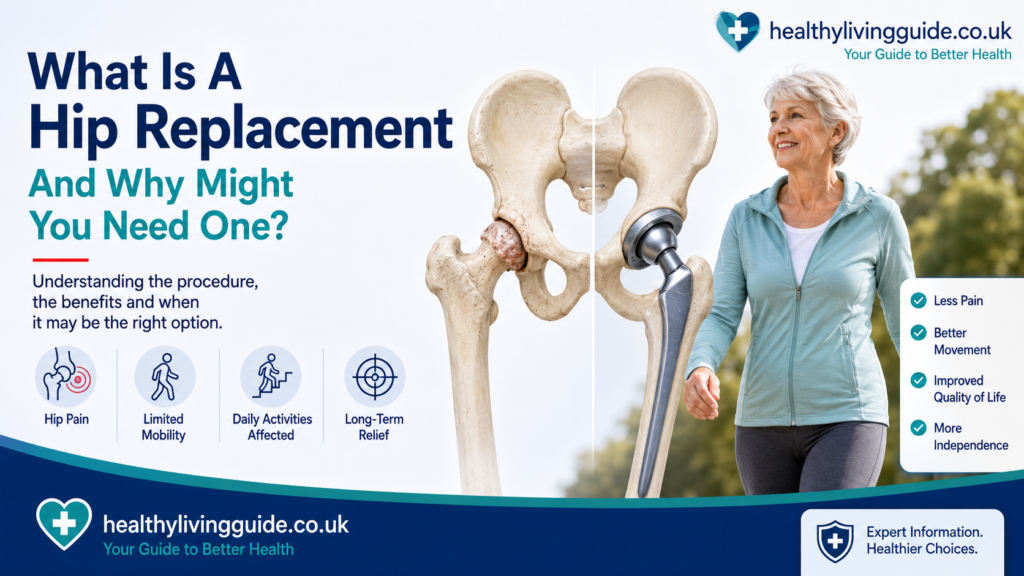
A hip replacement is an operation where a damaged or worn hip joint is replaced with an artificial joint. The artificial parts are often called implants or prostheses.
The hip is a ball-and-socket joint. The ball is at the top of the thigh bone, and the socket is part of the pelvis. When the joint becomes badly damaged, movement can become painful, stiff and restricted. Everyday activities such as walking, climbing stairs, getting in and out of a car, sleeping comfortably, putting on socks or standing for long periods can become difficult.
The most common reason for hip replacement is osteoarthritis. This is wear and tear of the joint where the protective cartilage breaks down over time. However, hip replacement may also be considered for other problems, including rheumatoid arthritis, hip fractures, childhood hip conditions, avascular necrosis, previous injury, or other joint damage.
A hip replacement is usually considered when non-surgical treatments have not given enough relief. These may include:
- Painkillers or anti-inflammatory medication
- Physiotherapy
- Strengthening exercises
- Weight management if appropriate
- Walking aids
- Steroid injections in selected cases
- Lifestyle changes
- Activity modification
Surgery is normally considered when hip pain is affecting your quality of life, sleep, independence, mobility, work or ability to carry out normal daily activities.
There are different types of hip replacement.
A total hip replacement replaces both the ball and socket parts of the joint.
A partial hip replacement replaces only part of the joint and is often linked to certain types of hip fracture.
A hip resurfacing is less common and may be considered in selected patients.
A revision hip replacement is a more complex operation where an earlier hip replacement is repaired or replaced. Revision surgery usually costs more than a first-time hip replacement.
This article mainly focuses on a standard private total hip replacement, because that is what most people mean when they search for private hip replacement cost UK.
The main thing to understand is that hip replacement is a major operation with potential benefits and risks. It can reduce pain and improve mobility for many people, but it requires proper assessment, preparation, surgery, rehabilitation and follow-up.
How Much Does A Private Hip Replacement Cost In The UK In 2026?
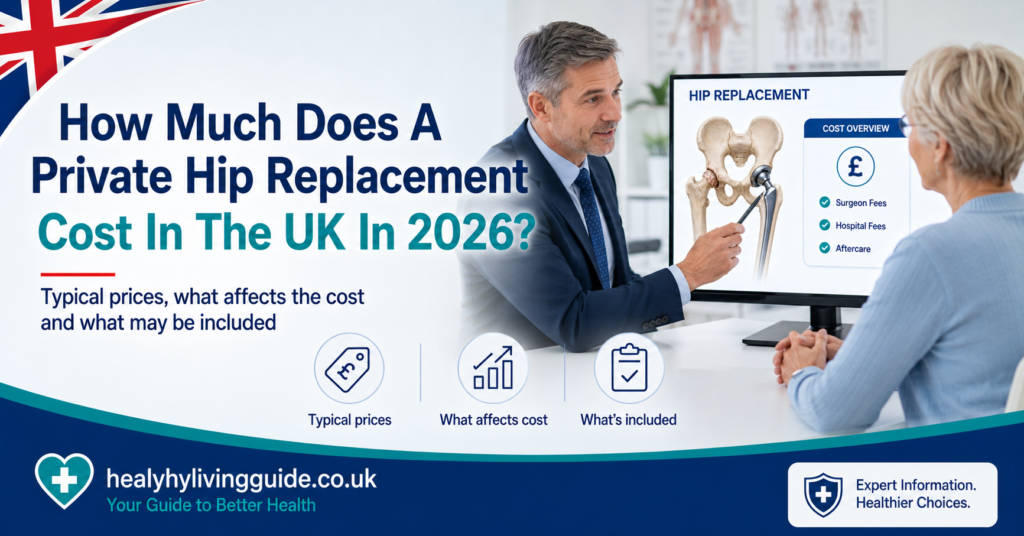
In 2026, a private hip replacement in the UK commonly costs around £11,000 to £16,500 or more.
A useful planning range for many self-pay patients is around £13,000 to £15,500 for a standard total hip replacement, but this depends on the provider, surgeon, location and package.
Some hospitals may quote package prices around the lower end of the range. Others may charge more, especially in London or for specialist technology, complex cases, specific implants, robotic-assisted surgery or longer hospital stays.
Here is a simple guide to typical private hip replacement costs in the UK:
| Private hip replacement item | Typical UK cost range |
|---|---|
| Initial orthopaedic consultation | £200 to £300+ |
| Private total hip replacement package | £11,000 to £16,500+ |
| Common self-pay planning range | £13,000 to £15,500 |
| Pre-operative tests | Sometimes included, sometimes extra |
| Surgeon and anaesthetist fees | Usually included in package quotes, but check |
| Hip implant or prosthesis | Usually included, but type may affect price |
| Hospital stay | Often included for a set number of nights |
| Physiotherapy | Some sessions may be included |
| Follow-up appointments | Sometimes included, sometimes extra |
| Revision hip replacement | Usually more expensive |
The important word is package.
A private hospital may advertise a fixed or guide price, but you need to know what that package actually includes. A price that looks cheaper may not include everything you need. A price that looks higher may include more aftercare, physiotherapy or follow-up.
A private hip replacement quote may include:
- The surgeon’s fee
- The anaesthetist’s fee
- Hospital theatre costs
- The hip implant
- Nursing care
- A set hospital stay
- Pre-operative assessment
- Basic tests before surgery
- Medication during admission
- Some physiotherapy
- Follow-up appointment
- Aftercare advice
However, it may not always include:
- The first consultation
- Diagnostic imaging before surgery
- Extra blood tests
- Additional physiotherapy
- Longer hospital stay
- Treatment for complications
- Specialist equipment for home
- Extra follow-up appointments
- Revision surgery if needed later
- Treatment for unrelated medical problems
This is why you should not compare only the headline price. You need to compare the full package.
Before booking, ask the provider:
“Is this a fixed price or a guide price?”
Then ask:
“What exactly is included, and what could I be charged extra for?”
For a major operation like hip replacement, clarity matters. You do not want to find out after surgery that physiotherapy, follow-up, scans or extra nights in hospital are not included.
What Is Usually Included In A Private Hip Replacement Package?
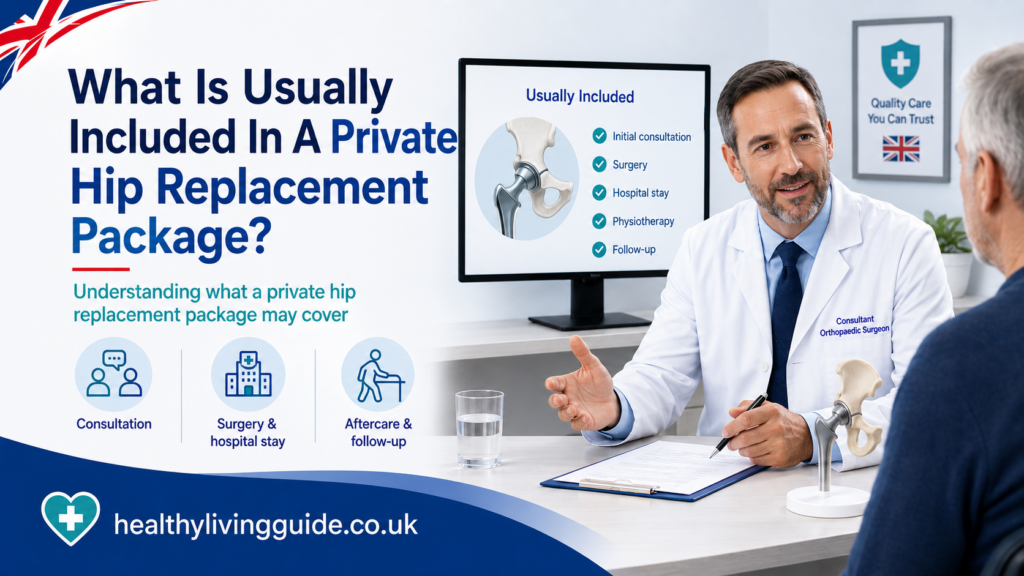
A private hip replacement package can vary between hospitals, but it often includes the main surgery and essential hospital care.
Your journey will usually begin with an orthopaedic consultation. The consultant will ask about your symptoms, medical history, pain level, walking ability, previous treatment, medication, work, daily activities and how the hip problem affects your life. They may examine your hip, check your movement and review X-rays or scans.
If surgery is being considered, the consultant should explain the benefits, risks, alternatives and likely recovery. They should also discuss whether you are suitable for surgery and whether private treatment is appropriate.
A typical private hip replacement pathway may include:
Initial consultation
This is where you meet the orthopaedic surgeon. The consultation may or may not be included in the package price. Some providers charge it separately.
Imaging and diagnosis
You may need an X-ray, MRI or other imaging. Sometimes this has already been done through the NHS or another provider. Sometimes private imaging is arranged before surgery. Check whether imaging is included.
Pre-operative assessment
Before surgery, the hospital will usually check your general health. This may include blood tests, blood pressure, heart checks, medication review and questions about existing conditions. The aim is to reduce risk and make sure you are fit for anaesthetic and surgery.
Surgeon fee
This is the fee for the orthopaedic surgeon who carries out the operation. In many private packages, this is included, but it is still worth confirming.
Anaesthetist fee
Hip replacement usually involves anaesthetic. This may be spinal anaesthetic, general anaesthetic, sedation, or a combination depending on your health and clinical plan. The anaesthetist fee is often included in package prices, but check.
Theatre and hospital costs
The package usually includes theatre time, equipment, nursing care and use of the hospital facilities.
Hip implant
The artificial hip joint is usually included, but the type of implant may affect the price. Some implants and techniques may cost more.
Hospital stay
Many patients stay in hospital for one to three nights after a hip replacement, depending on their recovery, mobility, pain control and medical condition. Some packages include a set number of nights. Extra nights may cost more.
Physiotherapy
Physiotherapy is an important part of hip replacement recovery. Some private packages include inpatient physiotherapy and a limited number of outpatient sessions. Others may include less. Ask exactly how many sessions are included.
Medication and discharge advice
You may be given pain relief, blood clot prevention medication, wound care advice and instructions for going home. Check whether take-home medication is included.
Follow-up appointment
Many packages include at least one follow-up appointment with the surgeon. Some include more. If you need extra follow-up, this may cost more.
Here is a simple checklist to ask about:
| Item | Is it included? |
| Initial consultation | Ask clearly |
| X-rays or scans | Ask clearly |
| Pre-operative assessment | Usually included, but check |
| Surgeon fee | Usually included in package |
| Anaesthetist fee | Usually included in package |
| Implant | Usually included, but type matters |
| Hospital stay | Usually included for set number of nights |
| Physiotherapy | Often limited, ask how many sessions |
| Medication after discharge | Ask clearly |
| Follow-up appointment | Sometimes included |
| Complication care | Ask what is covered and for how long |
A private hip replacement is expensive, so always ask for the full package details in writing.
What Can Make The Final Price Higher?

The final price of a private hip replacement can rise for several reasons.
The first factor is the hospital location. Private surgery in London and some major cities can cost more than surgery in other parts of the UK.
The second factor is the consultant surgeon. Some surgeons charge more depending on experience, demand, location or specialist expertise.
The third factor is the type of implant. Different implants and materials can affect the price. Your surgeon should explain why they recommend a particular implant and whether it changes the cost.
The fourth factor is the surgical technique. Some providers offer robotic-assisted surgery or computer-assisted technology. This may cost more than standard surgery. It may be suitable for some patients, but it is worth asking whether it is necessary for your case and what evidence supports it.
The fifth factor is the length of hospital stay. If your package includes two nights but you need an extra night, you may be charged more. This can happen if pain control, mobility, blood pressure, wound checks or general recovery take longer than expected.
The sixth factor is your general health. If you have other medical conditions, you may need extra assessment, more monitoring, or involvement from other specialists. This can affect the pathway and cost.
The seventh factor is pre-operative tests and scans. If you need additional imaging, blood tests, heart checks or other investigations, these may not always be included.
The eighth factor is physiotherapy. Basic physiotherapy may be included, but ongoing rehabilitation after discharge may cost extra. Recovery from hip replacement can take months, so do not ignore rehab costs.
The ninth factor is complications. Most people do not experience serious complications, but complications can happen. Infection, blood clots, dislocation, wound issues or other problems may require further treatment. Ask what your private package covers if complications occur.
The tenth factor is revision surgery. A first-time hip replacement is usually less complex than revision surgery. If you are replacing an old implant, the operation may be more complicated and more expensive.
The eleventh factor is insurance. If you are using private medical insurance, your own cost may depend on your policy excess, exclusions, pre-authorisation and hospital list. Your insurer may not cover every consultant, hospital, implant or technique.
Before booking, ask these questions:
- Is this a fixed price or a guide price?
- Is the initial consultation included?
- Are X-rays or scans included?
- Are surgeon and anaesthetist fees included?
- Is the implant included?
- Does the price change depending on the implant?
- How many nights in hospital are included?
- How much is an extra night?
- How many physiotherapy sessions are included?
- Are follow-up appointments included?
- What happens if I have a complication?
- What is the maximum likely total cost?
- If using insurance, has the insurer authorised everything?
The safest approach is to get the full quote in writing and read the small print before committing.
NHS Vs Private Hip Replacement Which Route Makes Sense?

For many people in the UK, the NHS is the right route for hip replacement. NHS treatment does not require you to pay privately for the operation, and your GP can refer you to an NHS orthopaedic service if your symptoms and clinical situation support it.
The NHS route may make sense if:
- You cannot afford private surgery
- You prefer NHS treatment and follow-up
- Your symptoms are manageable while waiting
- You have complex health needs
- You want your GP and local NHS hospital to coordinate care
- You are already on an NHS waiting list
- You are not sure whether surgery is definitely needed
Private hip replacement may make sense if:
- Your pain is seriously affecting your life
- You want faster access
- You can afford self-pay treatment
- You have private medical insurance
- You want more choice over hospital or surgeon
- You want clearer appointment timing
- NHS waiting times in your area are long
- You have already tried non-surgical treatments
Private care can offer faster access, but it does not remove the need for proper clinical decision-making. You still need to be assessed by a qualified orthopaedic specialist. You still need to understand the risks. You still need to prepare for recovery.
Private does not automatically mean better surgery. The quality of care depends on the surgeon, hospital, safety standards, aftercare, your health, your recovery and your rehabilitation.
For some people, waiting for NHS surgery may be reasonable. For others, the pain and loss of mobility may make waiting very difficult. That is a personal decision that should be made with medical advice and a clear understanding of cost.
A useful question to ask yourself is:
“Is the main issue pain, mobility and quality of life, or am I only trying to avoid waiting?”
Another important question is:
“If I pay privately, can I also afford the recovery support I may need afterwards?”
Hip replacement recovery does not end when you leave hospital. You may need help at home, time off work, transport, physiotherapy, pain management, walking aids and patience.
If you are already on an NHS waiting list, ask your GP or hospital how private treatment could affect your NHS pathway. If you have private surgery but need follow-up later, be clear about whether this will be private, NHS or insurance-funded.
How To Prepare For Hip Replacement Surgery And What Happens On The Day
Preparation for hip replacement starts before the operation. The better prepared you are, the easier your recovery may be.
Your hospital will give you specific instructions. Follow those instructions carefully because advice can vary depending on your surgeon, anaesthetic plan, age, health and medication.
Before surgery, you may be advised to:
- Stay as active as your pain allows
- Do strengthening exercises if recommended
- Stop smoking if you smoke
- Reduce alcohol intake
- Improve general fitness where possible
- Manage weight if advised
- Prepare your home
- Arrange transport
- Arrange help after discharge
- Review medication with the hospital team
- Attend pre-operative assessment
- Follow fasting instructions before surgery
Preparing your home is important. After hip replacement, bending, twisting and moving around may be difficult at first. You may need to think about:
- A safe sleeping area
- Removing trip hazards
- Keeping essentials within easy reach
- Arranging a raised toilet seat if advised
- Using a firm chair with arms
- Planning meals
- Organising someone to help with shopping
- Avoiding low seats
- Making sure stairs are safe
- Keeping a phone nearby
On the day of surgery, you will usually arrive at the hospital and be admitted. Staff will confirm your details, check your observations, review medication and answer final questions. You may meet the surgeon and anaesthetist again before the operation.
The anaesthetist will explain the anaesthetic plan. Some people have a spinal anaesthetic, which numbs the lower body. Some have general anaesthetic. Some have sedation. The right approach depends on your health and clinical situation.
During the operation, the surgeon removes the damaged parts of the hip joint and replaces them with artificial components. The operation may take around one to two hours, although timings vary.
After surgery, you will go to recovery and then back to the ward. Staff will monitor your blood pressure, pain, wound, circulation and movement. You will usually be encouraged to start moving with help, often quite soon after surgery, depending on your hospital’s pathway.
Physiotherapists will help you begin walking safely with aids such as crutches or a frame. They may also teach exercises and explain movement precautions.
Before discharge, the team will check that you can move safely enough, manage stairs if needed, understand medication, and know what to do if you have concerns.
After going home, you may need to:
- Take pain relief as advised
- Take blood clot prevention medicine if prescribed
- Do your exercises
- Keep the wound clean and dry
- Attend follow-up appointments
- Use walking aids as advised
- Avoid certain movements if instructed
- Avoid driving until cleared
- Gradually build mobility
- Watch for signs of complications
Recovery can take several months. Some people improve quickly, while others take longer. Your age, general health, fitness, type of surgery, motivation and support at home can all affect recovery.
Seek urgent medical advice after surgery if you have:
- Chest pain
- Shortness of breath
- Calf pain or swelling
- Sudden severe hip pain
- Wound redness, heat, swelling or discharge
- Fever
- New numbness or weakness
- A fall
- Signs the hip may have dislocated
- Symptoms that feel serious or unusual
Hip replacement can be life-changing for many people, but recovery needs proper care.
Questions To Ask Before Booking And Final Thoughts
Before booking private hip replacement, ask detailed questions. This is a major operation and a large financial decision, so you need clarity.
Do I definitely need a hip replacement?
Ask the surgeon whether surgery is clearly recommended or whether non-surgical options are still worth trying.
What type of hip replacement is being recommended?
Ask whether it is total hip replacement, partial hip replacement, resurfacing or revision surgery.
What implant will be used?
Ask what type of implant is recommended, why it is suitable for you, and whether it affects the price.
What is included in the quoted price?
Ask about consultation, scans, pre-assessment, surgeon fee, anaesthetist fee, implant, hospital stay, nursing care, physiotherapy, medication and follow-up.
What could cost extra?
Ask about extra nights, extra physiotherapy, further tests, extra follow-up, complications and changes to the surgical plan.
How many nights in hospital are included?
Ask what happens if you need to stay longer.
What physiotherapy is included?
Ask whether only inpatient physiotherapy is included or whether outpatient sessions are part of the package.
What happens if there is a complication?
Ask what complication cover is included, how long it lasts, and what is excluded.
What recovery support will I need at home?
Ask what equipment, help, transport, time off work and home adjustments may be needed.
What are the risks?
Ask about blood clots, infection, dislocation, nerve injury, leg length difference, implant loosening, stiffness, fracture and need for revision surgery.
How experienced is the surgeon?
Ask how often they perform hip replacements and whether they specialise in your type of case.
What happens if I use insurance?
Ask your insurer to confirm authorisation, excess, hospital cover, consultant cover and any exclusions before booking.
FAQ
How much does private hip replacement cost in the UK?
Private hip replacement in the UK commonly costs around £11,000 to £16,500 or more. Many self-pay patients should budget around £13,000 to £15,500 for a standard total hip replacement, but the final price depends on hospital, surgeon, implant, location and package.
Is private hip replacement worth it?
It may be worth it if pain is seriously affecting your life, NHS waits are long, you can afford treatment, or you have private medical insurance. However, it is a major operation and should only be done after proper medical assessment.
Is the consultation included in the price?
Not always. Some hospitals include the consultation in a package, while others charge separately. Always ask before booking.
Does the price include the hip implant?
Most private hip replacement packages include the implant, but the type of implant may affect the price. Ask your surgeon what implant will be used and whether there are any extra costs.
How long do you stay in hospital after private hip replacement?
Many people stay around one to three nights, depending on recovery, mobility, pain control and medical condition. Ask how many nights are included in the package.
How long does recovery take after hip replacement?
Recovery can take several months. Some people feel much better within weeks, but full recovery, strength and confidence can take longer. Follow your surgeon and physiotherapist’s advice.
Can I drive after hip replacement?
You should not drive until you are safe and cleared according to medical advice and legal requirements. This usually depends on pain, mobility, strength, reaction time and whether you can safely control the vehicle.
What are the risks of hip replacement?
Risks can include blood clots, infection, dislocation, leg length difference, nerve or tissue damage, fracture, implant loosening, stiffness and the possible need for further surgery. Your surgeon should explain your personal risks.
Can I pay monthly for private hip replacement?
Some private providers offer finance or payment plans. Check whether interest applies and whether you can afford repayments before agreeing.
Can I go private if I am already on an NHS waiting list?
You may be able to, but ask your GP, NHS provider and private hospital how this affects your pathway and follow-up. If you use insurance, also check authorisation first.
Final Thoughts
Private hip replacement is one of the bigger self-pay healthcare decisions a person can make. It can cost around £11,000 to £16,500 or more, with many people needing to budget around £13,000 to £15,500 for a standard private total hip replacement.
The price is important, but it is not the only thing that matters. You also need to understand the surgeon’s recommendation, the implant, hospital stay, physiotherapy, follow-up, complication cover and recovery plan.
Do not choose based only on the lowest advertised price. Choose based on clinical suitability, safety, transparency, aftercare and your ability to manage recovery.
Before booking, get the full quote in writing, ask what is included, understand what could cost extra, and make sure you are comfortable with the recovery journey.
Your hip, mobility and long-term quality of life matter. The right decision is the one made with clear medical advice, realistic expectations and full understanding of the costs involved.
Important Medical Disclaimer
This article is for general information only. It is not medical advice and should not be used to decide whether you need surgery. Hip pain can have many causes. Always speak to your GP, physiotherapist, orthopaedic specialist or appropriate healthcare professional before making treatment decisions. If you have sudden severe pain, cannot bear weight, have signs of infection, have had a fall, or feel acutely unwell, seek urgent medical help.