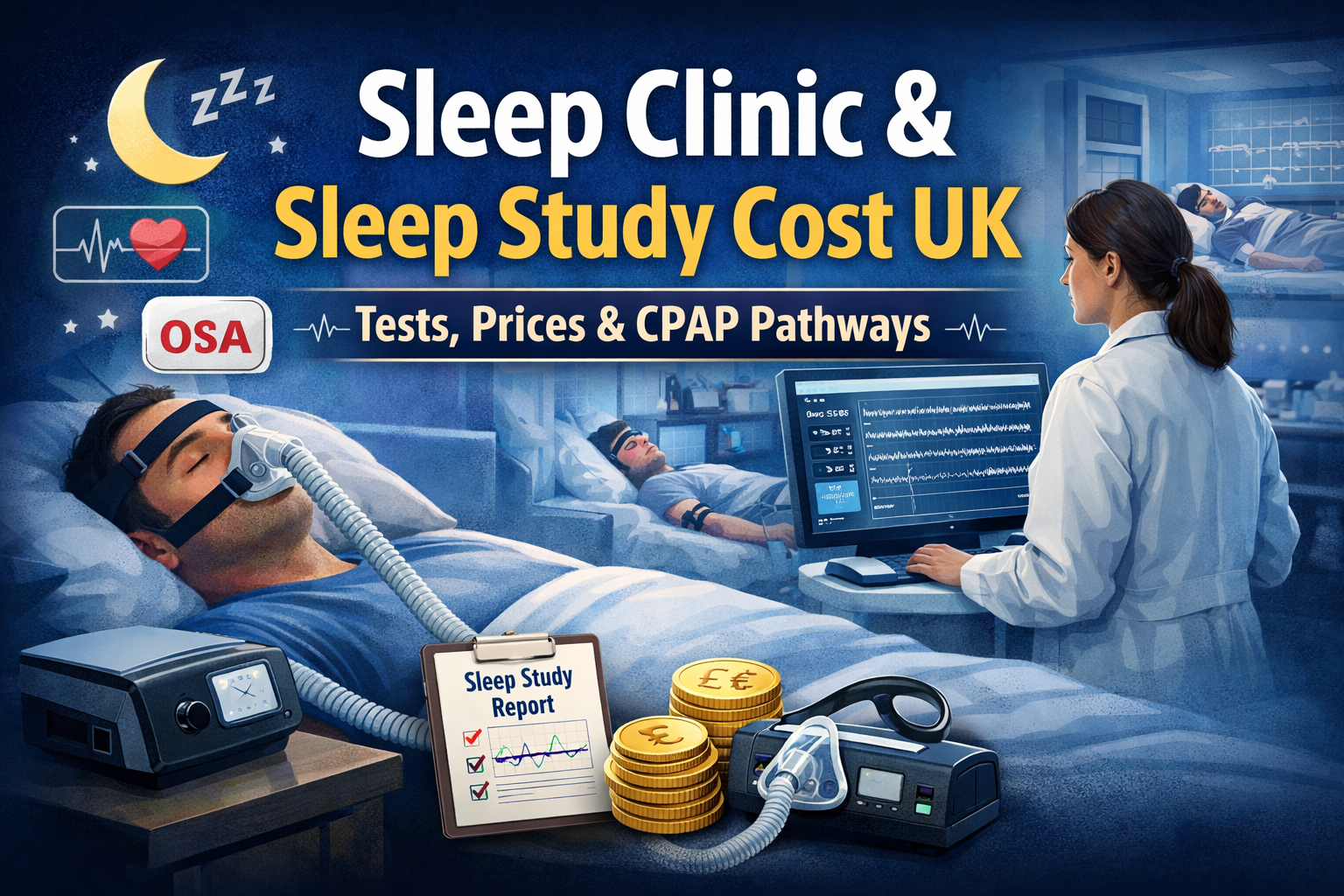
Sleep problems can quietly wreck your energy, mood, focus, weight, blood pressure and even your safety behind the wheel. If you’re waking up unrefreshed, snoring loudly, choking or gasping at night, or battling daytime sleepiness, a sleep clinic referral or private sleep study can be the quickest route to real answers.
This guide breaks down the UK sleep clinic pathway, the main sleep tests, typical prices (NHS vs private), and what usually happens next, including the CPAP pathway for sleep apnoea.
Quick Answer For Busy Readers
- Most NHS sleep apnoea testing starts at home with a monitoring device after GP referral.
- Private home sleep tests are often £150–£350, with published examples from £189 to £360+ depending on provider and what’s included.
- In-lab polysomnography (PSG) is typically much more expensive, commonly £600–£1,200+ in pricing guides, with some published hospital-fee examples around £880 (consultant fee may be extra).
- If OSA is confirmed, CPAP is the common pathway for more significant cases, with NHS provision for eligible patients and private routes available.
What A UK Sleep Clinic Actually Does
A sleep clinic is not only for insomnia. In the UK, a large share of referrals relate to sleep-disordered breathing, especially obstructive sleep apnoea (OSA).
A sleep service can help you:
- Identify the most likely cause (OSA, insomnia, restless legs, circadian rhythm issues, narcolepsy, parasomnias)
- Choose the right test (home study vs in-lab PSG)
- Interpret results properly (not just “positive” or “negative”)
- Start treatment (CPAP or alternatives)
- Track progress (especially CPAP comfort and adherence)
NHS Vs Private Sleep Study Pathway In The UK
NHS Pathway
A typical NHS route looks like this:
- GP appointment (symptoms, risk factors, Epworth Sleepiness Scale)
- Referral to a sleep/respiratory clinic if indicated
- Home sleep test in many suspected OSA cases
- Results + plan
- CPAP setup and follow-up if moderate to severe OSA (service-dependent)
Private Pathway
Private is usually faster and more flexible:
- Self-referral is often possible
- Choice of home test vs in-lab PSG
- Faster interpretation and quicker access to CPAP
- Some providers publish fixed prices; others quote after consultation
Key tip: Don’t just buy a test. Choose a pathway that includes a clear interpretation and a next-step plan.
Types Of Sleep Tests Used In The UK And When You Need Each One
Home Sleep Apnoea Test (HSAT)
You sleep at home with a device that measures breathing, oxygen levels, pulse, and sometimes snoring, position and movement.
Best for: loud snoring, witnessed apnoeas, daytime sleepiness, high OSA risk
Respiratory Polygraphy
Often used in NHS and private settings for suspected OSA. Similar home-based concept with respiratory channels.
Best for: confirming OSA and grading severity when symptoms strongly fit
Overnight Oximetry
A simpler oxygen test. Useful screening tool, but can miss some cases.
Best for: quick screen or monitoring response in selected situations
In-Lab Polysomnography (PSG)
The most detailed overnight study, typically in a sleep centre. It can include EEG brain activity, breathing, oxygen, heart rhythm and limb movements.
Best for: complex cases, unclear home results, suspected parasomnias, seizures, limb movement disorders, neurological sleep problems
CPAP Titration / CPAP Setup
If OSA is confirmed, settings and mask fit matter. Some pathways use APAP; others use a titration approach.
Best for: confirmed OSA starting CPAP/APAP or struggling with settings
MSLT (Multiple Sleep Latency Test)
A daytime test often done after an overnight study to assess pathological sleepiness.
Best for: suspected narcolepsy or hypersomnia syndromes
Actigraphy
A watch-like tracker worn for days/weeks to assess sleep timing and regularity.
Best for: circadian rhythm disorders and sleep pattern assessment
Sleep Clinic And Sleep Study Cost UK Real World Price Ranges
Prices vary by home vs in-lab, who interprets the study, and what follow-up support is included.
Table: Typical Private Prices By Test Type
| Test Or Service | Typical Private Price Range | Notes |
|---|---|---|
| Home sleep study (HSAT) | ~£150–£350 (common) | Often 1-night; some offer 2-night options |
| Home sleep study published examples | £189, £325 (2-night), £360+ | Examples depend on provider and inclusions |
| Sleep clinic consultation | ~£150–£250+ | Varies by specialist/clinic and location |
| In-lab PSG (polysomnography) | ~£600–£1,200+ | Higher because of facility, staff, scoring |
| Hospital-fee example for private respiratory sleep study | ~£880 (example) | Consultant fee may be separate |
| CPAP titration/setup (private guide range) | ~£150–£400 | Varies by pathway and support included |
A) Private Home Sleep Study Cost UK HSAT
Published examples you referenced include:
- £189 home sleep test example
- £325 for a 2-night home sleep study listing
- £360 for a standard home sleep apnoea test on a major brand’s UK clinic page
A broader “industry-style” range often quoted is £150–£350, depending on what’s included.
Before you pay, check this list
- Is it 1 night or 2 nights?
- Do you get a written report?
- Is there a follow-up call/appointment?
- If CPAP is needed, do they provide a prescription pathway and support?
B) Private Sleep Clinic Consultation Fees
Consultations vary widely. Some clinics advertise initial appointments around £150, while specialist consults can start around £250 depending on clinic and location.
C) In-Lab Polysomnography PSG Cost UK
In-lab PSG is typically much more expensive than home testing. You referenced guide ranges around £600–£1,200, plus examples such as a published £880 hospital-fee component for a private respiratory sleep investigation (sometimes excluding consultant fees).
D) CPAP Titration Or Setup Cost UK
For private routes, setup may be a separate fee. You referenced a common guide range around £150–£400.
E) Ongoing CPAP Costs Private Buying Vs NHS
On the NHS, CPAP is provided for appropriate cases as part of care.
Privately, costs can include:
- Machine (CPAP/APAP)
- Mask
- Tubing/filters
- Replacement cushions and parts
You referenced examples showing CPAP machines often in the mid-hundreds (often £600–£800+ depending on model/bundles) and replacement parts like mask cushions around £32.
Which Test Should You Choose Without Wasting Money
Start With A Home Sleep Study If
- Your symptoms strongly suggest OSA (snoring, witnessed apnoeas, daytime sleepiness)
- You want the fastest, most affordable first step
- You don’t have complex neurological symptoms
Go Straight To In-Lab PSG If
- Home tests are inconclusive
- Symptoms suggest parasomnias, seizures, unusual movements or REM behaviour issues
- You may need PSG + MSLT for suspected narcolepsy/hypersomnia
- A clinician recommends a full study due to complexity
Rule of thumb: If the story screams OSA, start home-first. If it’s complicated or doesn’t add up, PSG saves time and repeat testing.
Understanding Sleep Study Results So You Know What You’re Paying For
For suspected OSA, results often include:
- AHI (apnoea-hypopnoea index: events per hour)
- Oxygen dips (desaturation measures)
- Position effects (worse on your back for some people)
- Sometimes snoring patterns/intensity
Don’t let “borderline” results end the conversation. The real value is a proper explanation of:
- how severe it is
- whether symptoms match the numbers
- which pathway makes sense for you
CPAP Pathway UK NHS And Private From Diagnosis To Better Sleep
Step 1 Confirm Diagnosis
Most people start with a home-based study, especially when OSA looks likely.
Step 2 Decide CPAP Vs Alternatives
Your clinician should consider:
- Severity (AHI + oxygen dips)
- Symptoms (sleepiness, headaches, mood, blood pressure)
- Weight and anatomy
- Sleep position and alcohol/sedative use
Alternatives may include:
- Mandibular advancement device (MAD)
- Weight management
- Positional therapy
- Treating nasal obstruction/allergies
- ENT evaluation in selected cases
Step 3 CPAP Setup Mask Plus Pressure
This is where success is made or lost.
Common setup models:
- APAP (auto-adjusting)
- Titration-based setup in selected cases
Step 4 The First 2 To 4 Weeks
Most CPAP “failures” are fixable:
- Mask leaks
- Dry mouth/nose
- Claustrophobia
- Pressure discomfort
- Wrong mask type (nasal vs full-face)
Step 5 Long-Term Follow-Up
Over time you may need:
- Replacement cushions/filters
- Mask refitting if weight changes
- Support if symptoms return
How To Maximise CPAP Comfort And Actually Stick With It
- Mask fit beats mask price
- Nasal breathing helps (manage congestion safely with clinician advice)
- Humidity matters (dryness is a common quit reason)
- Don’t overtighten (often worsens leaks)
- Practice hour (wear it while watching TV to adapt faster)
FAQs
How Much Does A Private Sleep Study Cost In The UK
Home sleep apnoea testing is often £150–£350, while in-lab PSG is commonly £600–£1,200+, depending on what’s included. Published examples range from £189 to £360+ for home testing.
Is A Sleep Study Free On The NHS
If you meet clinical criteria and are referred through the NHS, sleep clinic assessment and testing are generally provided as part of NHS care.
Do I Need In-Lab PSG Or Will A Home Test Do
If symptoms strongly suggest OSA, many people start with a home test. PSG is often used for complex cases, unclear results, or suspected non-OSA disorders.
How Much Does A CPAP Machine Cost In The UK If I Go Private
Private CPAP costs vary by model and bundles, but pricing is commonly in the mid-hundreds, often £600–£800+ for popular devices, plus mask and ongoing replacement parts.
The Smart Way To Choose A Sleep Test And Avoid Paying Twice
If your goal is fast diagnosis and a clear treatment pathway:
- Start with a reputable home sleep test if OSA is likely
- Make sure it includes a proper report and clinical review option
- If CPAP is needed, choose a pathway with support, not just a device
- Escalate to PSG if your case is complex or results don’t match symptoms
Disclaimer
This article is for general information only and does not replace medical advice. If you have severe daytime sleepiness, near misses while driving, or breathing pauses at night, speak to your GP promptly.