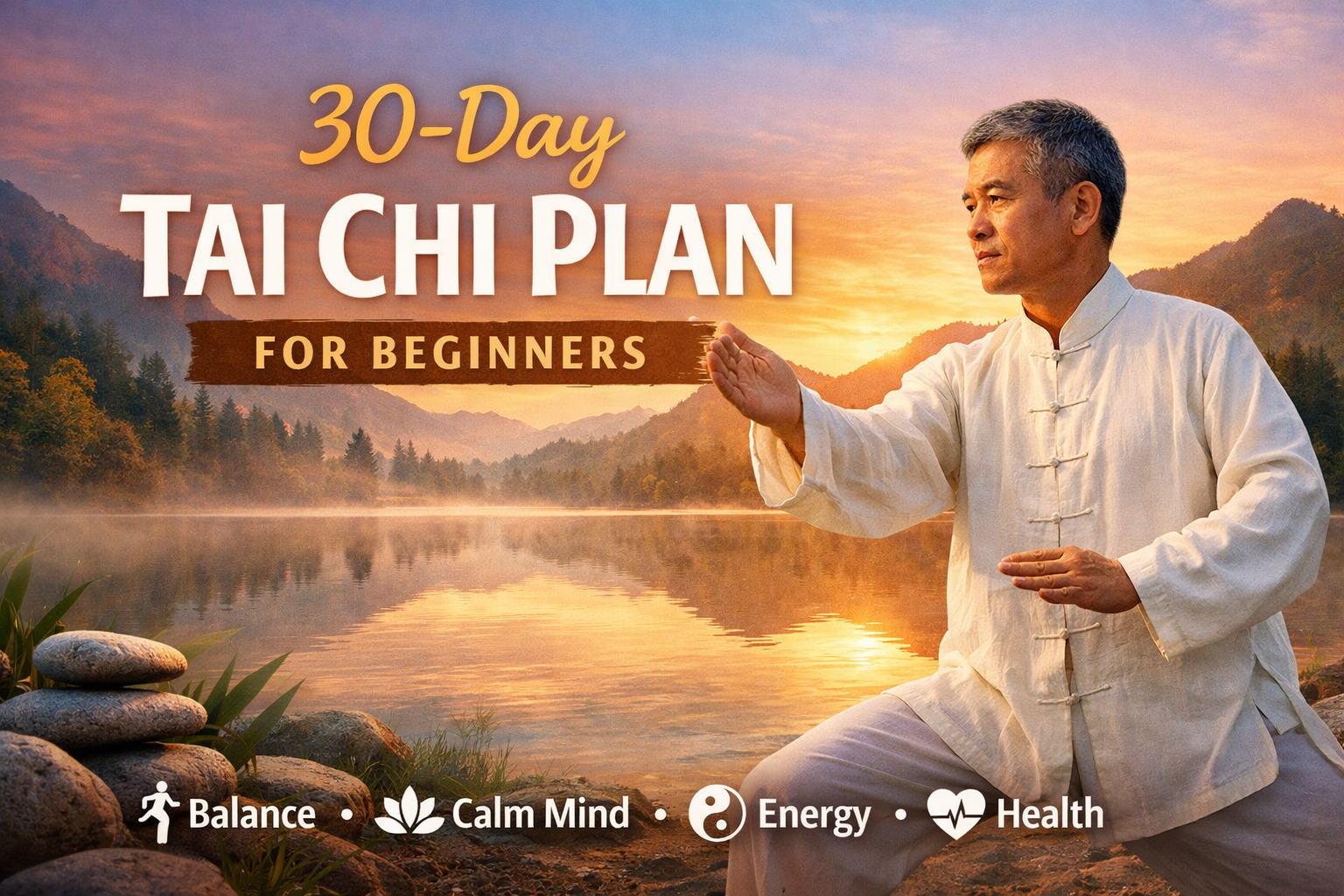
Tai Chi is often described as meditation in motion, but that phrase only captures part of its value. At its core, Tai Chi is a gentle yet powerful practice that connects the body and mind through slow, deliberate movement. For someone starting out, it can feel unfamiliar, even slightly awkward at first. Yet within a few days, many beginners begin to notice something subtle but profound. Their breathing slows, their posture improves, and their thoughts become quieter.
This 30 day plan is designed to guide you from complete beginner to confident practitioner. It does not require prior experience, expensive equipment, or perfect fitness. It simply asks for consistency and a willingness to move with awareness.
By the end of these 30 days, you will not only understand the foundations of Tai Chi, but you will also have built a daily habit that can support your physical health, mental clarity, and overall wellbeing.
Understanding Tai Chi Before You Begin
Before stepping into the daily plan, it helps to understand what you are actually practicing. Tai Chi is a traditional Chinese martial art, but unlike fast or aggressive styles, it focuses on softness, balance, and flow.
Every movement in Tai Chi follows a few core principles:
Slow and controlled motion
Relaxation without collapse
Alignment of posture
Deep and natural breathing
Continuous movement without stopping
These principles matter more than memorising movements. In fact, beginners often progress faster when they focus on how they move rather than what they perform.
Tai Chi is also deeply connected to the idea of energy flow within the body. Whether you interpret this scientifically or philosophically, the practical result is the same. You become more aware of how your body moves, how tension builds, and how to release it.

What You Need To Get Started
One of the advantages of Tai Chi is its simplicity. You do not need a gym membership or specialised gear.
All you need is:
Comfortable clothing that allows free movement
Flat shoes or bare feet
A quiet space, indoors or outdoors
Ten to twenty minutes per day
If you can practice outside, even better. A park, garden, or open space adds a calming environment that enhances the experience.
Week 1 Building Awareness And Foundations
During the first week, the focus is not on complex movements. It is about learning how to stand, breathe, and move slowly with intention.
Day 1 Finding Your Posture
Stand with your feet shoulder width apart. Keep your knees slightly bent, not locked. Let your arms hang naturally by your sides.
Focus on:
Keeping your back straight
Relaxing your shoulders
Breathing slowly through your nose
Spend ten minutes simply standing and breathing. This may feel simple, but it is the foundation of everything that follows.
Day 2 Learning Deep Breathing
Continue your standing posture. Now bring awareness to your breathing.
Inhale slowly through your nose
Let your belly expand naturally
Exhale gently through your mouth
Practice for ten to fifteen minutes. Avoid forcing your breath. Let it flow naturally.
Day 3 Introducing Weight Shifting
Stand in your base posture. Slowly shift your weight from one foot to the other.
Move gently from left to right
Keep your movements slow and controlled
Avoid leaning your upper body
This builds balance and coordination, two essential Tai Chi skills.
Day 4 Arm Floating Movement
From your standing position, slowly raise your arms in front of you to chest height, then lower them.
Inhale as you raise your arms
Exhale as you lower them
Repeat for ten minutes. Keep your shoulders relaxed and your movements soft.
Day 5 Combining Breath And Movement
Now combine your breathing with the arm movement and weight shifting.
Shift weight
Raise arms
Breathe in
Lower arms
Breathe out
Focus on smooth transitions rather than perfection.
Day 6 Slow Walking Practice
Take slow, deliberate steps forward.
Place your heel first
Shift weight gradually
Keep your body upright
Walk slowly for ten to fifteen minutes. This builds control and awareness.
Day 7 Review And Reflection
Repeat your favourite exercises from the week. Focus on improving your breathing and posture.
By now, you may begin to notice small changes such as improved balance or reduced tension in your shoulders.
Week 2 Introducing Basic Tai Chi Movements
In week two, you begin learning simple Tai Chi movements that form the basis of longer forms.
Day 8 Commencing Form Practice
Begin with your standing posture. Add a simple sequence:
Raise arms
Shift weight
Step forward
Lower arms
Practice slowly and repeat multiple times.
Day 9 Parting The Wild Horse Mane
This is a classic Tai Chi movement.
Step forward
One hand pushes forward
The other hand moves downward
Keep your movements slow and controlled. Practice both sides.
Day 10 White Crane Spreads Wings
Shift your weight back
Raise one arm upward
Lower the other arm
Focus on balance and stability.
Day 11 Brush Knee Movement
Step forward while one hand brushes past your knee and the other pushes forward.
This introduces coordination between upper and lower body.
Day 12 Combining Movements
Link together:
Parting the Wild Horse Mane
White Crane Spreads Wings
Brush Knee
Perform them slowly in sequence.
Day 13 Improving Flow
Focus on making your movements continuous.
Avoid stopping between steps
Maintain smooth transitions
This is where Tai Chi begins to feel more fluid.
Day 14 Weekly Review
Practice all movements learned so far. Take your time and focus on breathing, posture, and flow.
Week 3 Building Coordination And Balance
This week deepens your practice and introduces more refined control.
Day 15 Slowing Everything Down
Perform your movements at half speed.
This improves control and strengthens your muscles in a gentle way.
Day 16 Focusing On Balance
Hold each position for a few seconds before transitioning.
This builds stability and body awareness.
Day 17 Circular Arm Movements
Introduce circular motions with your arms.
Move in slow, controlled circles
Keep your shoulders relaxed
Day 18 Coordinating Arms And Legs
Focus on synchronising your steps with your arm movements.
Everything should move together in harmony.
Day 19 Mindful Practice
Pay attention to how your body feels.
Notice tension
Release unnecessary tightness
Day 20 Extending Practice Time
Increase your session to twenty minutes.
Maintain quality over quantity.
Day 21 Reflection And Adjustment
Review your progress.
Are your movements smoother
Is your breathing more relaxed
Make small adjustments.
Week 4 Developing Flow And Confidence
The final week focuses on bringing everything together.
Day 22 Full Sequence Practice
Perform all movements you have learned in one continuous sequence.
Take your time.
Day 23 Improving Transitions
Focus on how you move from one position to another.
This is where Tai Chi becomes truly fluid.
Day 24 Adding Visualisation
Imagine moving through water or air resistance.
This helps create smoother and more intentional movements.
Day 25 Deepening Breath Control
Coordinate every movement with your breath.
This enhances relaxation and focus.
Day 26 Practicing Outdoors
If possible, practice in a natural setting.
Fresh air and open space enhance the experience.
Day 27 Longer Flow Session
Practice for twenty to thirty minutes.
Maintain your focus throughout.
Day 28 Fine Tuning Technique
Pay attention to small details such as hand positioning and posture.
These refinements make a noticeable difference.
Day 29 Full Practice With Confidence
Perform your entire sequence with confidence and calmness.
By now, your movements should feel more natural.
Day 30 Completion And Continuation
You have completed your 30 day journey.
Reflect on your progress:
Improved balance
Better posture
Reduced stress
Greater awareness
Tai Chi is not something you finish. It is something you continue. From here, you can explore longer forms, deeper breathing techniques, or even join a local class to refine your skills further.
Benefits You Can Expect From Tai Chi
With consistent practice, Tai Chi offers a wide range of benefits.
Physically, it improves balance, flexibility, and coordination. It is especially useful for preventing injuries and improving posture.
Mentally, it reduces stress and promotes calmness. Many people find that Tai Chi helps them manage anxiety and improve focus.
Over time, it can also support better sleep, improved circulation, and overall wellbeing.
Common Mistakes Beginners Should Avoid
Many beginners make the same mistakes early on.
Moving too fast
Holding unnecessary tension
Focusing only on memorising movements
Ignoring breathing
The key is to stay relaxed and patient. Tai Chi is about quality, not speed.
Final Thoughts
This 30 day Tai Chi plan is not about perfection. It is about building a habit that connects your body and mind in a meaningful way.
Even ten minutes a day can create lasting change. The movements may be slow, but their impact builds steadily over time.
If you continue beyond these 30 days, you may find that Tai Chi becomes more than just exercise. It becomes a daily reset, a moment of calm in a busy world, and a quiet path toward better health and balance.
Disclaimer
This blog post is for informational and educational purposes only and does not constitute medical, health, or professional advice. Always consult your GP or a qualified healthcare professional before starting any new exercise programme, especially if you have pre-existing medical conditions, injuries, or concerns about your health.
While Tai Chi is generally considered a low-impact and safe form of exercise, individual results may vary. You should listen to your body at all times and stop immediately if you experience pain, dizziness, or discomfort. The author and publisher are not responsible for any injuries, losses, or damages that may occur as a result of following the information provided in this guide.
By following this 30 day Tai Chi plan, you acknowledge that you are participating at your own risk and take full responsibility for your health and wellbeing.