
If you have ongoing pain, worrying symptoms, or a specialist has suggested an MRI, the next question is usually simple: how much does a private MRI scan cost in the UK and how quickly can you get one?
This guide breaks down realistic UK price ranges, what’s usually included, how private wait times compare with the NHS, and the cheapest safe ways to get the imaging you need without wasting money.
Quick Answer: Typical Private MRI Prices In The UK
Private MRI prices vary mainly by body area, how many areas are scanned, whether you need contrast dye, and where you’re booking (London is often pricier).
A sensible “headline range” for self-pay is:
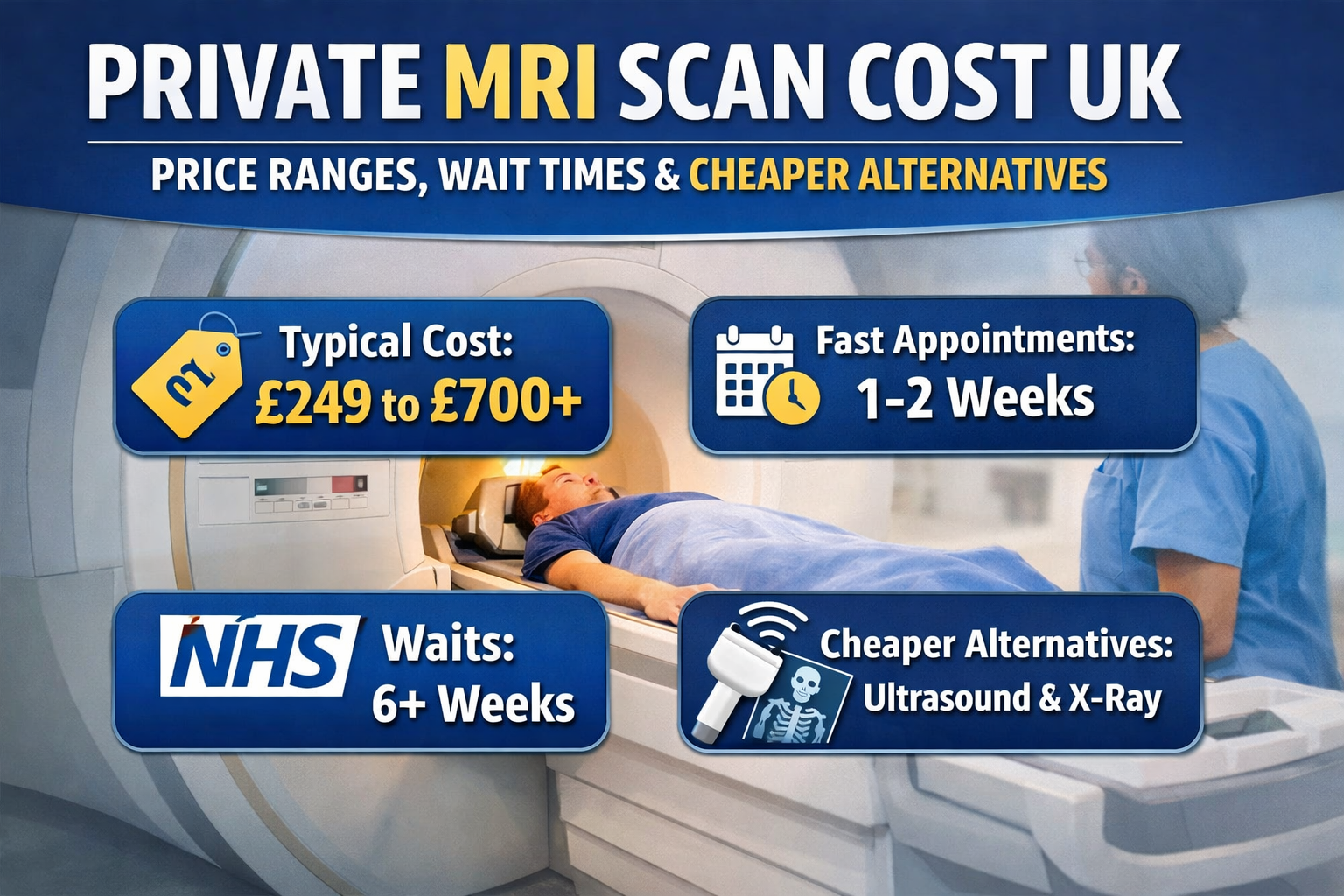
- Single-area MRI (one body part): roughly £249 to £700+
- Multi-area MRI (2+ areas): roughly £560 to £1,200+
- Full body style packages: roughly £765 to £2,000+
Those ranges are consistent with published example pricing from major UK providers (for example, prices starting from £249 at Vista Health, £275 at Oryon, ~£339 at Cobalt Health, £334 at Practice Plus Group, and examples around £590–£665 for “1 area” MRI on some hospital price lists).
Example Prices From UK Providers (Self-Pay)
These are examples from publicly listed pricing pages (always confirm your exact body part and what’s included before paying):
| Provider (example pages) | Example MRI Price Points (Self-Pay) |
|---|---|
| Vista Health | MRI from £249; off-peak £249; fast track within 7 days £380; total body package from £1,345; contrast add-on shown separately |
| Oryon Imaging (London) | Standard MRI from £275 |
| Cobalt Health | 1-part MRI from £339; multi-part bundles listed; contrast listed |
| Practice Plus Group | 1 body part £334; 2 body parts £560; 3 body parts £786; 4 body parts £1,012 |
| Nuffield Health (example hospital price lists) | “MRI Scan (1 part)” examples around £590–£592 |
| Spire (example hospital pricing page) | “MRI 1 area” example £665 |
Takeaway: If you’re price-shopping, you’ll often find the lowest self-pay deals from independent imaging centres and “off-peak” slots, while some private hospitals list higher fixed prices for “1 area” scans.
What Makes One MRI Cheaper Or More Expensive?
Here’s what usually changes the price the most:
1) Body Part And Scan Complexity
A simple “one joint” scan tends to be cheaper than complex abdomen/pelvis protocols or multi-area imaging. Some providers price by “1 area / 2 areas / 3 areas” which can be easier to compare.
2) Contrast Dye (Gadolinium)
If your clinician requests contrast, you’ll usually pay extra. Some price lists show contrast as a separate add-on (examples include £95 and £125 on different provider pages).
3) Speed And Appointment Type
Some providers explicitly price “fast track” appointments higher than standard scheduling (for example, “scan within 7 days” vs standard).
4) Location (London Premium)
London pricing can be higher; some providers publish London-specific guides with a wider price band.
5) What’s Included In The Fee
Always check whether your price includes:
- A radiologist report (and how fast)
- Access to images online or on disc
- Any referral/admin fee (if you need help arranging a referral)
For example, Vista Health states its fee includes a written report within a stated timeframe and online access to images.
Private MRI Wait Times In The UK (How Fast Can You Get One?)
Private MRI Wait Times
Private is popular for one reason: speed.
Some providers explicitly offer:
- Scan within 7 days options
- Evening/weekend availability
- Report turnaround in a few working days (provider-dependent)
In plain English: many people can get a private MRI within days to 1–2 weeks, depending on location and the type of scan.
NHS MRI Wait Times (Reality Check)
NHS diagnostic waiting times vary by area, demand, and staffing. The most useful high-level view is NHS England’s monthly diagnostics statistics.
In October 2025 (England):
- The MRI waiting list was 360,322 people
- 17.4% of MRI patients were waiting 6+ weeks
Across all 15 key diagnostic tests, NHS England reported:
- 1,786,700 people waiting for a key diagnostic test
- 380,600 waiting 6+ weeks (about 21.3%)
The Royal College of Radiologists also highlighted that in September 2025, large numbers of patients were waiting more than six weeks, including tens of thousands waiting too long for CT or MRI.
Important note: those are England figures; Scotland, Wales, and Northern Ireland publish their own stats and can look different.
How To Get A Cheaper Private MRI Without Cutting Corners
If you want the scan quickly and want to keep the cost down, use this checklist.
1) Ask For The Exact Scan Name
Prices jump when you accidentally book the wrong thing (e.g., “spine MRI” vs “lumbar spine MRI”, or “with contrast” vs “without”). If you have a referral, match the wording.
2) Compare “1 Area” vs “Multi-Area” Bundles
If you need more than one area imaged, bundling can reduce the average cost per area (some providers publish multi-area price ladders).
3) Use Off-Peak Slots
Off-peak pricing can be significantly cheaper than peak-time appointments (example: off-peak MRI from £249 on a provider page).
4) Don’t Pay Extra For Things You Don’t Need
Common add-ons include:
- Contrast (only if clinically needed)
- Extended reports or specialist reviews (useful sometimes, not always)
5) Use Interest-Free Spreading Where Available
Some providers advertise ways to spread costs (for example, interest-free instalments or medical loans).
6) Check If Your Workplace Or Insurance Covers Diagnostics
Even if you don’t have full private medical insurance, some employer benefits and policies cover diagnostics (MRI often falls under outpatient diagnostics). If you do have cover, confirm:
- Whether the insurer requires pre-authorisation
- Whether you must use a specific hospital network
Cheaper Alternatives To MRI (And When They Make Sense)
MRI is brilliant for soft tissue detail, but it isn’t always the first or cheapest test.
Ultrasound (Often Cheapest For Soft Tissue)
Ultrasound can be ideal for:
- Tendons and some muscle injuries
- Gallbladder issues
- Some pelvic and abdominal checks
Example starting prices published by one provider show ultrasound from £175.
X-Ray (Cheapest For Bone Problems)
Great for fractures, arthritis changes, and some chest issues. Example self-pay prices show X-rays from £138 (provider dependent).
CT Scan (Fast, Detailed, But Uses Radiation)
CT is often used for:
- Suspected internal injury
- Lungs and abdomen in urgent settings
- Certain cancer pathways
Example starting prices show CT from £445 on one provider pricing page, while some hospital lists can be higher.
When MRI Is Usually Worth It
MRI is commonly chosen when doctors need:
- Disc, nerve, or spinal detail
- Ligament/meniscus injuries
- Brain and neurological imaging
- Complex joint or soft-tissue issues
If you have severe symptoms (sudden weakness, facial droop, severe headache, loss of bladder/bowel control, suspected stroke, or symptoms of spinal cord compression), don’t price-shop—seek urgent medical care.
Do You Need A GP Referral For A Private MRI?
Often, yes—but there are workarounds.
Many private MRI providers accept referrals from:
- Your NHS GP
- A private GP
- A consultant
Some providers also offer a paid referral service or guided pathway for people who don’t already have a referral.
If you’re unsure, ask the clinic:
- “Can you accept an NHS GP referral?”
- “Is the radiologist report included?”
- “Do you send results to my GP?”
What Happens After The Scan (Results And Reports)
Typically you’ll receive:
- A radiologist report (often within days, depending on provider)
- Access to images (online portal, download, or disc)
Example provider statements mention written report timelines and online image access.
If you’re arranging the scan because you’re worried about a symptom, plan the “next step” in advance: who will interpret the report and manage treatment (your NHS GP, a physio, a private consultant, etc.).
FAQs
How much does a private MRI cost in the UK?
Most self-pay private MRIs sit roughly between £249 and £700+ for a single area, with full-body style packages higher.
Why are some hospitals £600+ for “1 area”?
Private hospitals may have higher fixed pricing structures, different reporting pathways, and bundled services. Example lists show “1 part/1 area” pricing around £590–£665 on some pages.
How quickly can I get a private MRI?
Often within days to about a week or two, depending on area and provider. Some providers advertise “within 7 days” options and extended opening hours.
Are NHS MRI waits really that long?
They can be. NHS England’s monthly diagnostics report showed 17.4% of MRI patients waiting 6+ weeks in October 2025 (England).
Is a full-body MRI worth it?
It depends on your goals and risk factors. It can create follow-up tests for “incidental findings.” If you’re considering it, discuss it with a clinician and ensure you understand what the package covers. Example pricing pages show full-body style MRI starting from the mid-hundreds to well over £1,000+.
What’s the cheapest imaging alternative to MRI?
Often X-ray (bone) or ultrasound (some soft-tissue/abdomen), depending on the clinical question. Example self-pay pricing pages list ultrasound and X-ray starting points lower than MRI.
Key Takeaways
- A realistic private MRI “headline range” is £249 to £700+ for one area, with multi-area and full-body packages costing more.
- Private scans are often available within days; some providers advertise within 7 days options.
- NHS waits vary, but official stats show a meaningful share of MRI patients waiting 6+ weeks in England.
- You can often cut costs using off-peak slots, multi-area bundles, and by avoiding unnecessary add-ons.
Medical Disclaimer
This article is for general information only and is not medical advice. If you have severe or worsening symptoms, contact a qualified clinician or urgent services.