
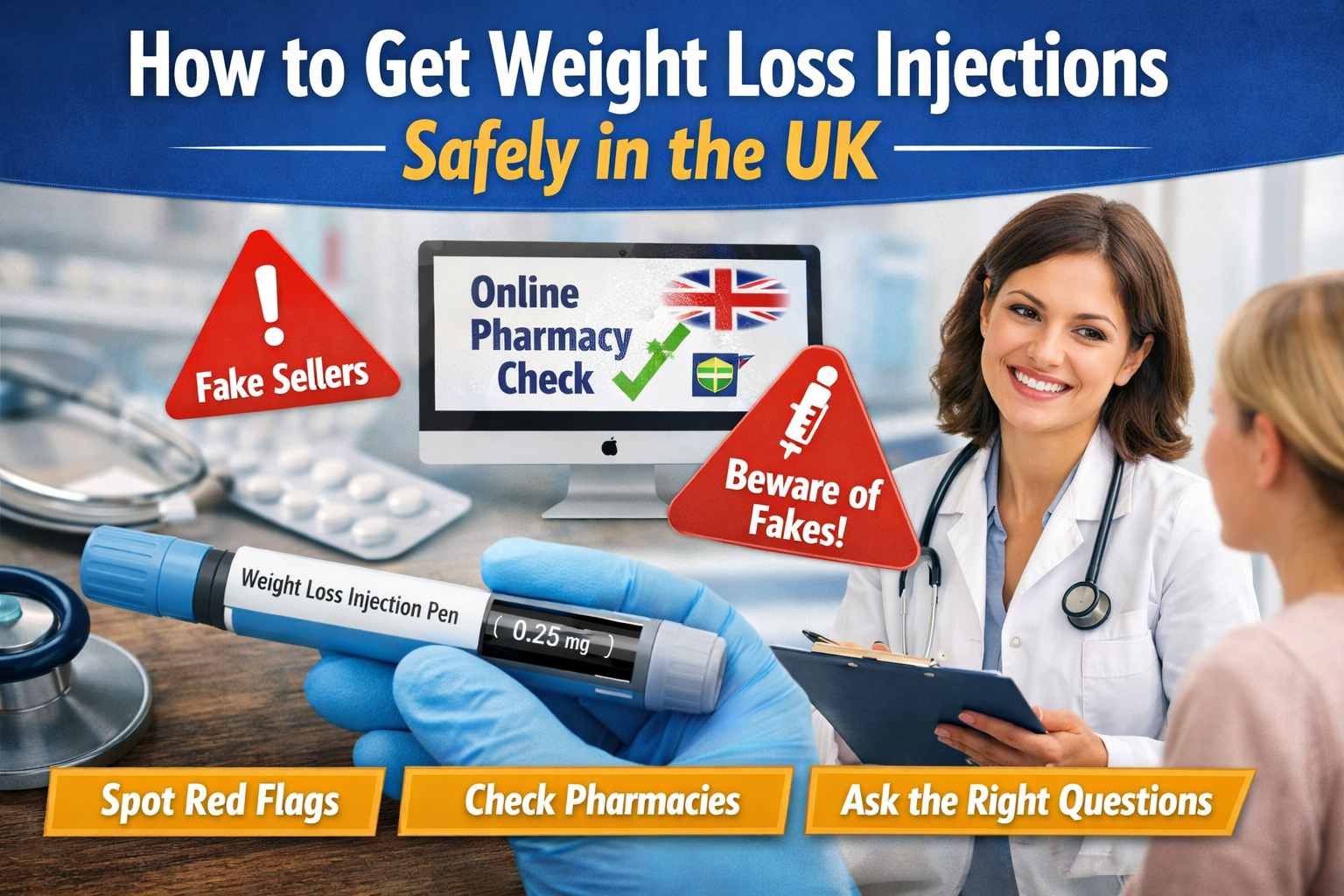
Weight loss injections can be life changing for the right person. They can also go badly wrong when people buy them from the wrong place, skip proper health checks, or end up with fake pens.
And right now in the UK, there’s a real problem with illegal sellers pushing “skinny jabs” via social media, beauty businesses, and fake pharmacy websites. The UK medicines regulator has explicitly warned people not to buy weight loss medicines without a prescription and not to treat them like cosmetic treatments.
This guide is here to help you stay safe, protect your money, and ask the right questions so you get proper care rather than a risky shortcut.
Important: This article is general information, not medical advice. Always speak to a qualified clinician (GP, specialist, or registered prescriber) before starting, switching, or stopping any prescription medicine.nse.
Quick Safety Checklist First
If you only read one section, read this.
The safest route looks like this:
- A proper clinical assessment (not just a 60 second questionnaire)
- A prescription from a qualified prescriber
- Supply from a legitimate UK pharmacy (including legitimate online pharmacies)
- Follow up and monitoring, especially while doses are being increased
If any of these are missing, walk away. The MHRA says the only way to guarantee you receive a genuine medicine is via a legitimate pharmacy against a prescription.
What Counts As A Weight Loss Injection In The UK
In the UK, the most talked about injectable medicines for weight management include:
- Semaglutide (Wegovy) for obesity management in line with NICE guidance
- Tirzepatide (Mounjaro) recommended by NICE for managing overweight and obesity in eligible adults
- Liraglutide (Saxenda) is authorised in the UK for weight loss (with diet and exercise)
You’ll also hear people mention Ozempic. It’s semaglutide too, but it’s authorised for type 2 diabetes, not weight loss. It may be prescribed “off label” in some situations, but you should never be sold it as a casual weight loss product.
NHS Vs Private In 2026 What To Expect
NHS access
Access on the NHS is prioritised for people with the highest clinical need, and it’s delivered alongside “wraparound” lifestyle support.
For example, NHS England has set out phased rollout rules for tirzepatide, with early access focusing on people with BMI 40+ (adjusted for ethnicity) and multiple weight related health problems.
NICE guidance and NHS implementation details can change over time, and local availability can vary by area, so it’s normal to hear “yes in one region, not yet in another.”
Private access
Private clinics and online pharmacies may offer these medicines faster, but “faster” must not mean “sloppy.” The risk with private is not the medicine itself, it’s the shortcut culture:
- poor screening
- weak follow up
- fake products
- bad storage and delivery
This is exactly why UK regulators keep warning the public about illegal supply routes.
Red Flags That Should Make You Leave Immediately
If you spot any of these, don’t negotiate. Just leave.
Seller and platform red flags
- Sold through Instagram, TikTok, Facebook groups, WhatsApp, Telegram, or “DM to order”
- Sold by a beauty salon, “aesthetic practitioner” who can’t clearly explain prescribing and pharmacy supply
- “Coaching package” where the medicine is basically treated as a free add on
- Prices that are too cheap, bulk discounts, or “limited time bundles”
- No clear UK address, no phone number, no named pharmacist, no real complaints process
Medical red flags
- No proper medical history taken (or it’s a tiny tick box form only)
- No checks on current medicines, allergies, pancreatitis history, gallbladder issues, pregnancy plans, eating disorders, or mental health
- No clear plan for side effects, dose changes, and follow up
- Pressure tactics like “everyone is doing it” or “you don’t need to tell your GP”
Product red flags
- Packaging looks wrong, spelling mistakes, foreign language leaflets, broken seals
- The pen arrives warm when it should have been kept cold (some products require careful temperature controlled handling)
- No batch number, no patient information leaflet, no pharmacy label with your details
- Anything described as a “research peptide” or unlicensed medicine (for example “retatrutide” sold outside trials)
The MHRA has warned about fake pens being found in the UK, and about people being hospitalised after using suspected fakes.
How To Check An Online Pharmacy Properly In The UK
A professional looking website means nothing. Do these checks instead.
1 Check the pharmacy and the clinician are registered
The NHS advises that if you buy medicines online you should ensure:
- the online pharmacy is registered with the GPhC
- the online doctor service is registered with the CQC and the prescriber is registered with the GMC
If a site hides who the prescriber is, that’s a red flag.
2 Understand the logos and what they do and don’t mean
- Great Britain (England, Scotland, Wales): The EU “distance selling logo” is not required since 1 January 2021. So don’t rely on it as a pass fail test.
- Northern Ireland: Online sellers must still use the EU common logo and be registered with the MHRA for that scheme. There’s also an MHRA register for NI sellers.
Bottom line: registration and traceability matter more than a badge.
3 Make sure the process allows real two way communication
Good practice guidance for online pharmacy services emphasises proper safeguards, including the ability for timely two way communication so the prescriber can ask follow up questions when needed.
So if it’s “pay now, medicine shipped” with no real conversation, treat it as unsafe.
What A Safe Clinical Assessment Should Cover
Whether you’re going NHS or private, a safe assessment usually includes:
- Weight, height, BMI, waist measurement (sometimes)
- Blood pressure (often)
- Health history and current diagnoses
- Current medication list (including contraception, HRT, and supplements)
- Alcohol intake, smoking, and lifestyle patterns
- Eating behaviour screening (including binge eating)
- Pregnancy plans and contraception
- Side effect risks and warning symptoms
- A plan for follow up and what happens if you stop
NHS England also flags practical safety points like telling your surgical team if you’re taking these medicines, and specific considerations around tirzepatide and oral contraception absorption.
What To Ask A Clinician Before You Start
Use this list word for word if you want. A good clinician will welcome it.
Eligibility and goals
- “Am I actually eligible for this medicine, or should we try something else first?”
- “What realistic weight loss range should I expect, and by when?”
- “How will we measure success beyond the scales?” (waist, blood pressure, bloods, mobility)
Safety and interactions
- “What are my personal risk factors for serious side effects?”
- “Do any of my current medicines interact with this?”
- “What should I do if I get severe vomiting, dehydration, or abdominal pain?”
- “What are the rules around contraception or pregnancy planning?”
Dosing and follow up
- “What is the dose escalation schedule and what happens if side effects hit?”
- “How often will you review me, and what happens if I plateau?”
- “If I stop, how do we reduce regain risk?”
Practical and supply chain
- “Which pharmacy supplies this and how do they handle cold chain delivery if needed?”
- “What should the packaging include, and what do I do if it arrives damaged?”
- “How do I dispose of needles safely?”
If the answers are vague, rushed, or defensive, that tells you a lot.
If You Think You’ve Bought A Fake Pen Or Had A Bad Reaction
Take it seriously.
Stop using it and get urgent medical help if you have severe symptoms (for example severe abdominal pain, signs of allergic reaction, fainting, confusion, severe weakness, or anything that feels like an emergency).
Then:
- Report suspected side effects through the MHRA Yellow Card scheme (the MHRA specifically encourages reporting for GLP 1 medicines).
- Report illegal sellers. The MHRA has enforcement teams focused on illegal online sales and can take down websites and accounts.
And please don’t feel embarrassed. These scams are designed to look convincing.
FAQs For Weight Loss Injections
Can I buy weight loss injections without a prescription in the UK
Legally and safely, no. The MHRA has warned the public not to buy weight loss medicines without a prescription, including from social media and beauty salons, and notes that selling medicines that way is against the law.
Is it safe to order weight loss injections online
It can be safe if the provider is properly registered and does a proper assessment. The NHS warns that many websites sell fake medicines and advises checking registration of pharmacies and clinician services.
What is the biggest danger with “cheap jabs”
The biggest danger is not getting a bargain. It’s injecting something that is:
- counterfeit
- incorrectly dosed
- contaminated
- poorly stored
The MHRA has reported fake pens and hospitalisations linked to suspected fakes.
Key Takeaways
- Treat weight loss injections like what they are: powerful prescription medicines, not a cosmetic trend.
- Only proceed if there’s a real clinical assessment, a valid prescription, and supply from a legitimate pharmacy.
- Learn the red flags, verify registrations, and ask direct questions before paying.
- If something feels off, walk away. Your health is worth more than speed.
Disclaimer
This article is for general information only and does not provide medical advice. Weight loss injections are prescription-only medicines in the UK and may not be suitable for everyone. Always speak to a qualified healthcare professional (such as your GP, a registered prescriber, or a pharmacist) before starting, changing, or stopping any medication. Do not buy injectable weight loss medicines from social media sellers, beauty salons, or unregulated websites. If you experience severe side effects or think you’ve been given a counterfeit product, seek urgent medical help and report concerns via the MHRA Yellow Card scheme.