
Medical disclaimer: This guide is for information only and is not medical advice. If you think you may have ADHD, speak to your GP or a qualified clinician.
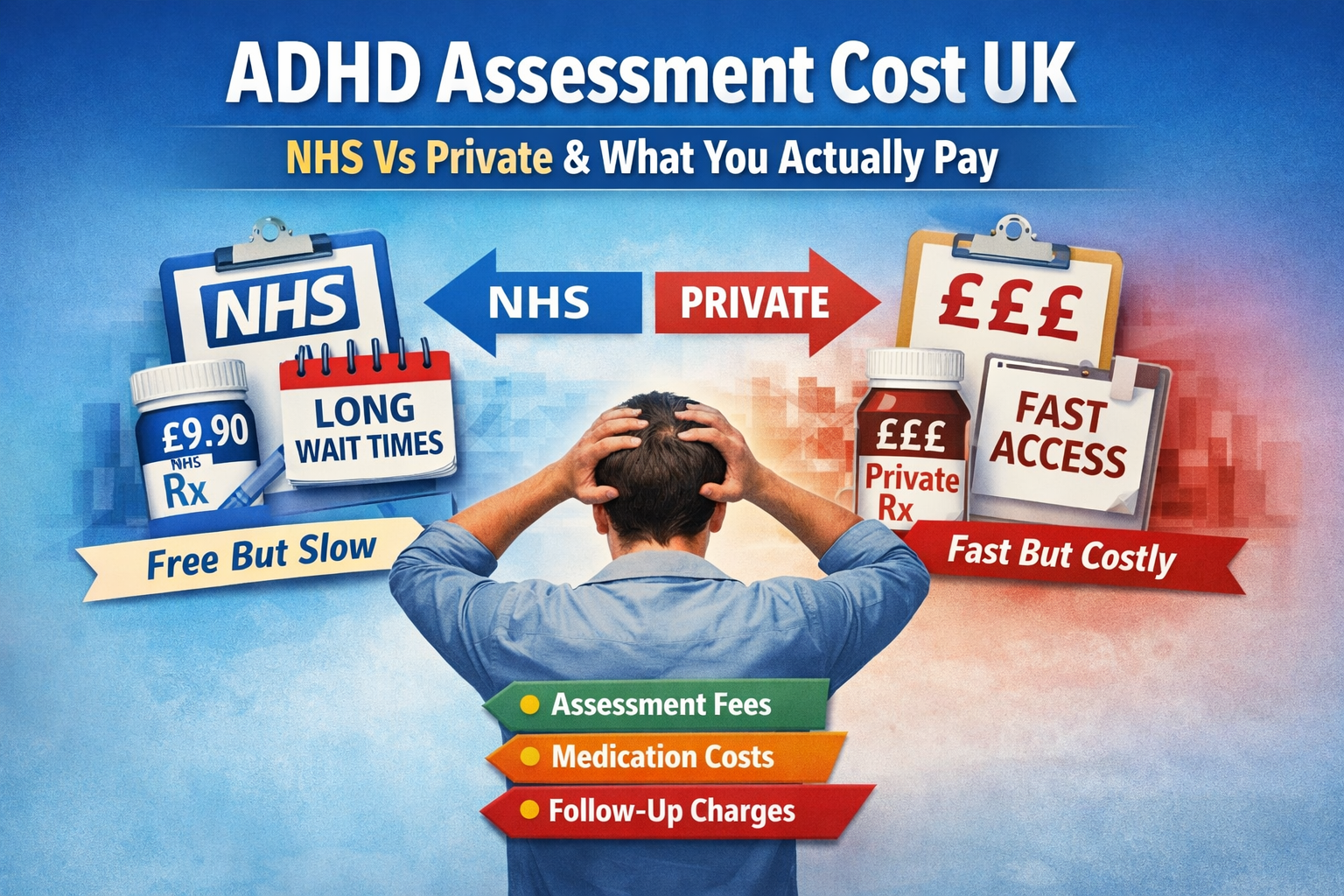
Adult ADHD assessments in the UK can feel confusing because “the price” is rarely just one number. The real cost depends on where you’re assessed (NHS vs private vs NHS Right to Choose), how quickly you need help, and whether you go on to medication titration and ongoing reviews.
This post breaks it all down in plain English so you can budget properly and avoid nasty surprises.
Quick Cost Snapshot (What Most People Actually Pay)
If you go through the NHS (standard local pathway)
- Assessment: £0 (NHS care is free at the point of use)
- Medication (England): usually £9.90 per prescription item unless you’re exempt (Scotland/Wales/Northern Ireland: prescriptions are generally free)
- Your “hidden costs”: time off work, travel, admin, chasing appointments
If you use NHS Right to Choose (England only, NHS-funded provider)
- Assessment: usually £0 (NHS funded)
- Timeline: often shorter than local NHS waits (varies by provider and month)
- Medication: same NHS prescription rules as above, once in an NHS pathway
If you go private
- Assessment: typically £700–£1,950 depending on provider and what’s included
- Follow-ups/titration: commonly £150–£360 per appointment plus medication costs
- Medication privately: often £60–£160+ per month (varies by medication and pharmacy)
- Big risk to budget for: your GP may not accept shared care, meaning you stay paying privately longer
What Counts As an “ADHD Assessment” in the UK (And Why It Matters for Price)
An ADHD assessment isn’t meant to be a quick checklist. NICE guidance sets expectations for recognising, diagnosing, and managing ADHD, including what clinicians should consider and how care should be reviewed.
In practice, a good-quality assessment often includes:
- pre-assessment screening questionnaires
- a detailed clinical interview (developmental history, school/work functioning, mental health, sleep, substance use)
- evidence across settings (home/work/education), sometimes using informant reports
- a written diagnostic report and treatment recommendations
Why this matters: some “cheap” private options look affordable upfront but may not include a detailed report, post-diagnostic plan, or proper follow-up—and that’s where people get stuck later, especially when trying to move into NHS prescribing.
NHS Route: What You Pay, How Long It Takes, And The Real Catch
Cost: mostly £0… with one major exception
If you’re assessed and treated fully within NHS services:
- the assessment itself is free
- ongoing reviews within NHS services are free
- medication costs depend on your nation and exemption status
England: NHS prescription charge is £9.90 per item (unless exempt).
Scotland: prescriptions are free.
Wales: prescriptions are free.
Northern Ireland: prescriptions dispensed in NI are free.
Timeline: the issue isn’t price — it’s waiting
Across the UK, waiting times can be long and vary hugely by area and whether you’re being seen for adult ADHD vs child ADHD. This is a key reason many people consider Right to Choose (England) or go private. Recent reporting has highlighted extremely long waits in parts of England and the strain on services.
The “hidden costs” people forget to budget for
Even when the NHS route is financially cheapest, it can be expensive in other ways:
- lost income from appointments and admin
- coping costs (missed deadlines, job issues, relationship strain)
- paying for interim support (coaching/therapy) while waiting
NHS Right To Choose (England): The “Free But Faster” Option
What it is (and who can use it)
In England, you typically have a legal right to choose certain providers at the point of referral, including for many mental health services, as long as the provider has an NHS contract and it’s clinically appropriate.
Some ADHD providers (for example, Psychiatry-UK) explain how their Right to Choose pathway works, who is eligible, and key restrictions (notably: you must have a GP in England and remain registered in England).
Cost: usually £0 for the assessment
Because it’s NHS funded, patients normally don’t pay for the assessment itself (the NHS pays the provider).
Timeline: often shorter — but not instant
ADHD UK publishes regularly updated waiting time estimates gathered from providers, showing how widely waits can vary.
The critical detail: shared care and ongoing prescribing
Even if you’re diagnosed via an NHS-funded provider, prescribing and long-term monitoring can involve GP cooperation and local commissioning rules. Some NHS/ICS guidance makes clear that GPs may decline shared-care prescribing if they don’t feel it’s safe or appropriate.
This matters because medication isn’t a “one-and-done” prescription. It needs monitoring, reviews, and sometimes dose changes.
Private Route: The Prices You See And The Prices You Actually Pay
Typical private assessment prices (real examples)
Private fees vary by provider, clinician type, assessment length, and what’s included:
- Psychiatry-UK lists Adult ADHD (Private) £950 (includes assessment, plan, report).
- A Harley Street provider lists adult ADHD assessment pricing (example: £715 virtual for adult ADHD assessment).
- A UK survey-style estimate found an average private ADHD assessment cost around £1,267 (with adult average around £1,200) based on 2024 research across clinics.
Takeaway: you’ll commonly see £700–£1,500 for adults, but higher fees exist—especially in premium settings or where a longer multi-session assessment is included.
What pushes the price up (and what might be missing)
Private packages differ. Before paying, check whether the fee includes:
- a full written report (not just a “diagnosis letter”)
- a treatment plan aligned to NICE principles
- post-diagnostic follow-up
- support during medication titration (if you want medication)
The “Hidden Costs” That Catch People Out (Especially With Medication)
If you’re diagnosed and want medication, your total spend usually grows in three ways:
1) Titration appointments (dose optimisation)
Medication often starts with titration, a monitored period where a clinician adjusts dose to balance benefits and side effects.
Private titration pricing varies widely:
- some providers list titration appointment fees (e.g., £150 titration appointment; other clinics list different rates)
- follow-up appointments can be £180 or more in some private fee schedules
- some clinics offer packages (e.g., “titration package” pricing)
2) Private prescriptions and medication costs
If you’re paying privately, you typically pay the pharmacy price (plus dispensing fees), and the monthly cost depends heavily on medication type and dose. Examples published by providers include:
- “average private prescription £60–£160 per month” (clinic estimate)
- example starting-dose prices for specific meds (provider guidance)
3) Ongoing reviews (every 6–12 months, sometimes more)
Many GP shared-care policies and clinic guidance emphasise the need for specialist review at least annually for ADHD medication.
If you stay fully private, you’ll likely pay for:
- 6-month or annual medication reviews (some clinics list these explicitly)
The Shared Care Reality (The Part That Can Double Your Costs)
People often assume: “I’ll pay for a private diagnosis, then my GP will prescribe on the NHS.” Sometimes that happens. But it’s not guaranteed.
Some NHS/ICS guidance is explicit: GPs do not have to prescribe shared-care meds if they feel unable to do so safely.
Some practices publish policies stating that if you’re diagnosed privately, you may still need NHS specialist assessment before NHS prescribing is considered.
Recent reporting in January 2026 describes growing pressure and cases where shared care is withdrawn or refused after private diagnoses, pushing patients into ongoing private costs.
Budgeting rule: If you go private and want medication, assume you may need to fund 3–12 months of titration + prescriptions privately unless your GP confirms shared care in advance.
Cost Breakdown: NHS vs Right to Choose vs Private (Real-World)
Here’s the simplest way to think about “what you actually pay”:
Option A: Local NHS pathway
You pay:
- £0 assessment
- £0 follow-ups within NHS
- Prescriptions (England): £9.90 per item unless exempt (free in Scotland/Wales/NI)
Trade-off: usually the longest waits.
Option B: NHS Right to Choose (England)
You pay:
- usually £0 assessment (NHS funded)
- prescriptions follow normal NHS rules
Trade-off: admin effort + ongoing prescribing arrangements still matter.
Option C: Private (diagnosis only)
You pay:
- £700–£1,950 typical assessment range depending on provider
Trade-off: faster assessment, but can be hard to convert to NHS prescribing later.
Option D: Private (diagnosis + medication for at least several months)
You pay (commonly):
- assessment fee
- titration appointments (often multiple)
- monthly private medication costs (often £60–£160+ as a rough working range; depends on medication/dose)
- ongoing reviews (6–12 monthly)
Trade-off: fastest route to treatment, highest total cost risk.
How To Reduce Your Out-of-Pocket Costs (Without Cutting Corners)
1) If you’re in England, explore Right to Choose early
Your GP referral is the gateway, and you can usually ask to be referred to a qualifying provider with an NHS contract.
2) Confirm shared care before paying privately (if medication is your goal)
Ask your GP practice:
- Do you accept shared care for ADHD medication?
- Under what conditions (which providers/standards)?
- Do you require NHS specialist involvement first?
Some NHS sources and local policies highlight the safety/governance reasons behind this.
3) Check if you qualify for free NHS prescriptions (England)
Use official eligibility guidance if cost is a concern.
4) Don’t overpay for “extras” you don’t need
Some clinics charge extra for:
- employer letters / “reasonable adjustments” letters
- university support letters
- repeat prescription admin fees
- “fast track” add-ons
If you need documentation, ask for a written list of fees upfront.
What To Ask Any Private Clinic Before You Pay
- Who will assess me? (GMC-registered psychiatrist or appropriately qualified clinician)
- Is the assessment NICE-aligned, and what evidence do you collect?
- Do I get a full written report and treatment plan?
- What are the follow-up fees and titration costs (total expected)?
- What are typical monthly medication costs on private prescriptions?
- Do you support shared care handover, and what documents do you provide?
- What happens if my GP refuses shared care? (Do you offer ongoing prescribing and at what cost?)
FAQs
Is Right to Choose available in Scotland, Wales, or Northern Ireland?
Right to Choose rules apply differently across the UK. Some providers state their RTC ADHD pathway is for patients registered with a GP in England and not available if you move outside England while waiting.
Can my GP refuse shared care?
Yes—some NHS/ICS guidance states GPs do not have to prescribe shared-care meds if they feel it cannot be done safely.
If I’m diagnosed privately, will the NHS accept it?
Sometimes, but not always. Some practice policies say NHS prescribing may require NHS specialist assessment, even with a private diagnosis.
What’s the cheapest route overall?
Purely on money: NHS (or NHS RTC in England) is usually cheapest because assessment costs are NHS funded and prescriptions follow NHS rules.
But the “cheapest” route can still feel costly if long waits create major life/work impacts.
Final Takeaway: Budget Like This
If you want a simple budgeting model:
- NHS / RTC: budget mainly for time + England prescription charges (if not exempt).
- Private diagnosis only: budget £700–£1,950.
- Private diagnosis + meds: budget assessment + 3–6+ follow-ups + monthly meds (often the difference between £1,200 total and £3,000+ total is shared care).
Disclaimer
The information in this article is provided for general educational purposes only and is not medical, clinical, legal, or financial advice. ADHD can overlap with other conditions, and only a qualified healthcare professional can assess your symptoms and provide a diagnosis.
Costs, waiting times, referral routes (including NHS and Right to Choose), medication availability, and shared care arrangements can vary by location, provider, and over time. Always check current fees directly with any private clinic and confirm local NHS/GP prescribing policies before making decisions or paying for services.
If you are concerned about your health, believe you may have ADHD, or are experiencing distress, contact your GP, NHS 111, or a qualified clinician for personalised advice. In an emergency, call 999 or go to A&E.
This website is not responsible for any loss or outcome arising from reliance on the information in this post.