Perimenopause can feel like your body has quietly changed the rules overnight. One month you’re fine, the next you’re waking at 3am, your patience is gone, your periods have a mind of their own, and you’re wondering whether this is “just stress” or something real.
Here’s the good news: most of the time, it is real, it is common, and you can absolutely get help. This guide gives you a clear checklist, explains when it’s time to book a GP appointment, and clears up the biggest confusion point of all: blood tests (what they can tell you, and what they can’t).
Quick note: This article is UK-focused. If you’re outside the UK, the principles still apply, but testing and pathways may differ. what you’ll pay, what you actually get, and the “hidden extras” that can push the total up.
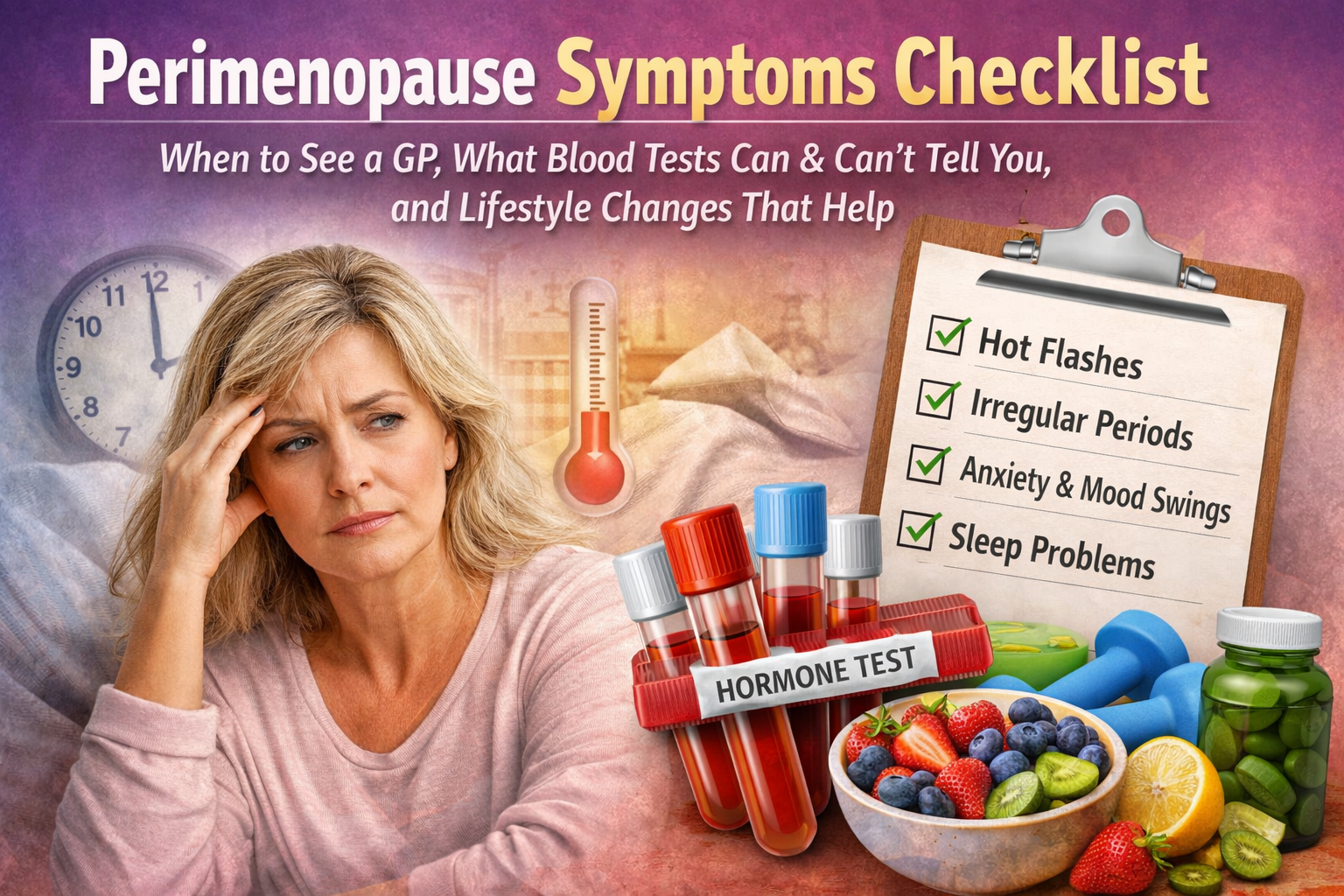
The 60-Second Perimenopause Checklist
Tick what’s been happening most weeks for at least a month, especially if it’s new or noticeably worse:
Period changes
- Periods are irregular (shorter cycles, longer cycles, skipped months)
- Bleeding is heavier or more unpredictable than your “normal”
- New spotting between periods
Heat and sleep
- Hot flushes (sudden heat, sweating, red face/neck)
- Night sweats
- Waking in the night and struggling to get back to sleep
- Feeling exhausted even after “enough” hours in bed
Mood and brain
- Anxiety that feels new or out of character
- Low mood, irritability, tearfulness, or mood swings
- Brain fog (forgetting words, losing your train of thought)
- Poor concentration or motivation
Body changes
- Weight gain around the middle, or body shape changes
- Aching joints or muscle pains
- Headaches or migraines changing pattern
- Palpitations (heart racing) especially with anxiety or hot flushes
- Lower libido
Vaginal and urinary changes
- Vaginal dryness, discomfort, or pain with sex
- Recurrent UTIs or burning sensations
- Needing to pee more often or urgently
Many of these are listed in UK symptom guides from NHS.
If you’re sitting there thinking, “That’s basically me,” keep reading—because the next step is not panic, it’s clarity.
What Perimenopause Actually Is (And Why It Can Be So Confusing)
Perimenopause is the transition phase before menopause, when ovarian hormone levels fluctuate. This fluctuation is the key word: it’s not a smooth decline. It’s more like a badly tuned radio—some days the signal is fine, other days it’s all static.
That’s why symptoms can come in waves:
- A month of terrible sleep, then two calmer weeks
- Anxiety out of nowhere, then it lifts
- A run of irregular bleeding, then a normal period again
And it’s why a single blood test can be misleading (more on that in a moment).
Symptom Checklist You Can Take To Your GP
If you want your GP appointment to be productive, it helps to walk in with something structured. Use this list and mark:
- When it started
- How often it happens
- How much it affects daily life
- Any pattern with your cycle
The “most common” cluster
These are frequently reported and commonly recognized symptoms:
- Hot flushes / night sweats
- Sleep disruption
- Mood changes (anxiety, low mood, irritability)
- Brain fog / memory and concentration issues
- Changes in periods
The “often overlooked” cluster
These also show up a lot, but people don’t always connect them to perimenopause:
- Joint aches and muscle pains
- Palpitations (especially around hot flushes/anxiety)
- Headaches changing pattern
- Skin dryness / itchy skin
- Vaginal dryness and recurrent UTIs
Tip: Track symptoms for 2–4 weeks (notes app is fine). A simple “0–10 severity score” for sleep, mood, hot flushes, and energy can make the appointment much easier.
When To See A GP (And When To Seek Urgent Help)
You don’t need to “tough it out” for months before speaking to someone. In the UK, guidance encourages seeing a GP if you think you have menopause symptoms, and blood tests may be considered especially if you’re under 45.
Book a GP appointment (soon) if:
- Symptoms are affecting work, relationships, sleep, or mental health
- Anxiety or low mood feels new, persistent, or scary
- Hot flushes/night sweats are frequent and disruptive
- Vaginal or urinary symptoms are recurring (dryness, pain, UTIs)
- You’re under 45 with symptoms (because early menopause/POI may need different assessment)
Ask for same-day help (urgent) if:
- You have thoughts of self-harm or feel unable to cope
- You have chest pain, severe shortness of breath, fainting, or stroke-like symptoms
- You have sudden severe abdominal/pelvic pain
Bleeding red flags (don’t ignore)
Perimenopause can cause cycle changes—but you should speak to a clinician promptly if you notice:
- Bleeding after sex
- Bleeding between periods that persists
- Very heavy bleeding (flooding through pads/tampons, clots, or dizziness)
- Bleeding that feels “not like you” and continues to worsen
These don’t automatically mean something serious, but they do deserve proper assessment.
What Blood Tests Can And Can’t Tell You
This is where a lot of people get stuck: you want proof. A number. A result you can point at and say, “See—this is why I feel like this.”
The problem is, during perimenopause hormones fluctuate, so a test can look “normal” on a random Tuesday and look different two weeks later.
If you’re 45 or over, diagnosis is usually based on symptoms
UK guidance says that in people aged 45 or over, perimenopause/menopause can be diagnosed from clinical history (symptoms) without relying on lab tests, because hormone levels fluctuate and results often don’t change management.
Tests that are not recommended to “confirm” perimenopause/menopause in 45+
Guidance says not to use tests like anti-Müllerian hormone (AMH), inhibin A/B, oestradiol, antral follicle count, or ovarian volume to identify perimenopause/menopause in people aged 45 or over.
What about FSH?
FSH (follicle-stimulating hormone) is the test people hear about most, but it has limits:
- Levels can swing up and down through the cycle and during the transition.
- It can be unreliable in certain contraception scenarios (for example, FSH isn’t recommended to identify menopause in people using combined hormonal contraception or high-dose progestogens).
RCOG has also warned against over-the-counter “menopause tests” that mainly measure FSH, because they don’t capture the wider clinical picture and fluctuate too much to be reliable.
When blood tests are useful
Blood tests can be appropriate when:
- You’re under 45, especially under 40, and early menopause/premature ovarian insufficiency (POI) is suspected
- Symptoms are unusual, the picture isn’t clear, or your clinician is ruling out other causes
A recent factsheet from the British Menopause Society also emphasizes that FSH testing isn’t helpful for diagnosing menopause over 45, but may be useful when early menopause is suspected in the 40–45 range, and is important in suspected POI under 40.
The “other checks” your GP may consider
Sometimes the right test isn’t “a menopause test” at all—it’s checking for lookalikes. Depending on your symptoms, a GP might consider:
- Thyroid function (thyroid issues can mimic anxiety, fatigue, palpitations)
- Full blood count (anaemia)
- Vitamin D/B12, HbA1c (blood sugar) in some cases
- Pregnancy test if there’s any chance (yes, it happens)
This is not about dismissing perimenopause. It’s about making sure nothing else is missed.
Lifestyle Changes That Help (Without Turning Your Life Into A Full-Time Project)
Lifestyle changes won’t “fix hormones,” but they can seriously reduce symptom intensity—especially sleep, mood, hot flush triggers, and energy.
Here are the ones with the best real-world payoff.
1) Sleep upgrades that actually work
If sleep is your main issue, start here:
- Keep your bedroom cool; lighter bedding helps
- Avoid alcohol close to bedtime (it fragments sleep)
- Cut caffeine after lunchtime if you’re sensitive
- Get morning daylight (10–20 minutes helps your body clock)
- Keep a “worry list” before bed so your brain stops looping
The NHS specifically recommends practical measures like keeping the bedroom cool and reducing triggers like caffeine, spicy food, smoking, and alcohol for hot flushes and night sweats.
2) Reduce hot flush triggers (don’t guess—test)
Common triggers include:
- Alcohol
- Caffeine
- Spicy foods
- Overheated rooms
- Stress spikes
Try a 10-day experiment: change just one trigger at a time. That way you learn what actually affects you.
3) Exercise: aim for consistency, not intensity
Exercise helps mood, sleep, weight management, and joint pain. The best plan is the one you’ll keep:
- 2–3 brisk walks per week
- 2 strength sessions (even 20 minutes at home)
- Gentle stretching if aches are an issue
If you’re exhausted, start tiny. Ten minutes still counts.
4) CBT can help more than people expect
If anxiety, low mood, or insomnia are taking over, menopause-specific CBT can be genuinely useful.
UK guidance suggests CBT can help with low mood/anxiety and sleep problems, and can also help manage hot flushes.
And updated recommendations from NICE say menopause-specific CBT can be considered for vasomotor symptoms (hot flushes/night sweats), either alongside HRT or when HRT isn’t suitable or preferred.
5) Food basics that support energy and cravings
You don’t need a fancy “menopause diet.” Start with:
- Protein at breakfast (helps cravings and steady energy)
- Fibre daily (veg, pulses, whole grains)
- Calcium + vitamin D awareness (bone health matters more as oestrogen falls)
- Hydration (especially if you’re getting night sweats)
6) Vaginal and urinary symptoms: don’t suffer in silence
Dryness, discomfort, and recurrent UTIs are common in the menopause transition. Many people assume they just have to accept it—but there are effective options (including non-hormonal moisturisers/lubricants and prescription treatments). It’s absolutely worth raising with a GP.
A Simple 4-Week Plan (So You’re Not Trying To Fix Everything At Once)
Week 1: Track and stabilise
- Track: sleep, mood, hot flushes, bleeding pattern
- Pick one sleep change (cool room, caffeine cutoff, bedtime routine)
- One daily walk (even 10 minutes)
Week 2: Tackle triggers
- Test one trigger (alcohol or caffeine is a strong start)
- Add one strength session (bodyweight squats, wall push-ups, bands)
Week 3: Mental load
- Try relaxation daily (10 minutes)
- If anxiety is strong, consider CBT routes (NHS talking therapies / GP referral)
Week 4: Book the GP (if symptoms persist)
Bring:
- Your symptom notes
- Your top 3 symptoms (the ones you most want solved)
- Any bleeding changes and timeline
- Any personal/family history that matters (clots, breast cancer, etc.)
Treatment Basics (Including HRT) In Plain English
Lifestyle changes help, but if symptoms are strong, treatment is worth discussing. NHS notes that for many people the benefits of HRT outweigh the risks, and that older fears about HRT are often based on outdated interpretations of earlier studies.
That doesn’t mean HRT is right for everyone—but it does mean you deserve a balanced conversation, not a brush-off.
If you’re not sure where you stand, your GP can talk you through:
- Your symptom priorities (sleep? hot flushes? mood? vaginal symptoms?)
- Your medical history and any contraindications
- Alternatives if HRT isn’t suitable or you’d rather not take it
FAQ
Can perimenopause cause anxiety?
Yes—anxiety and mood changes are commonly reported in perimenopause/menopause symptom lists.
Can I be perimenopausal if my periods are still regular?
Yes. Some people get sleep/mood/hot flush symptoms before cycles change much.
Can a normal hormone test rule out perimenopause?
Not reliably, especially if you’re 45+. Hormones fluctuate, and UK guidance highlights that lab tests don’t help diagnosis in this age group.
Should I buy an over-the-counter menopause test?
In general, be cautious. RCOG does not recommend OTC menopause tests as a good method for detecting menopause/perimenopause because they mainly measure FSH and don’t reflect the full clinical picture.
Medical Disclaimer
This article is for general information only and does not replace medical advice. If you think you may be experiencing perimenopause symptoms, or you have concerns about bleeding, mood, or your health, speak to a GP or qualified clinician.